
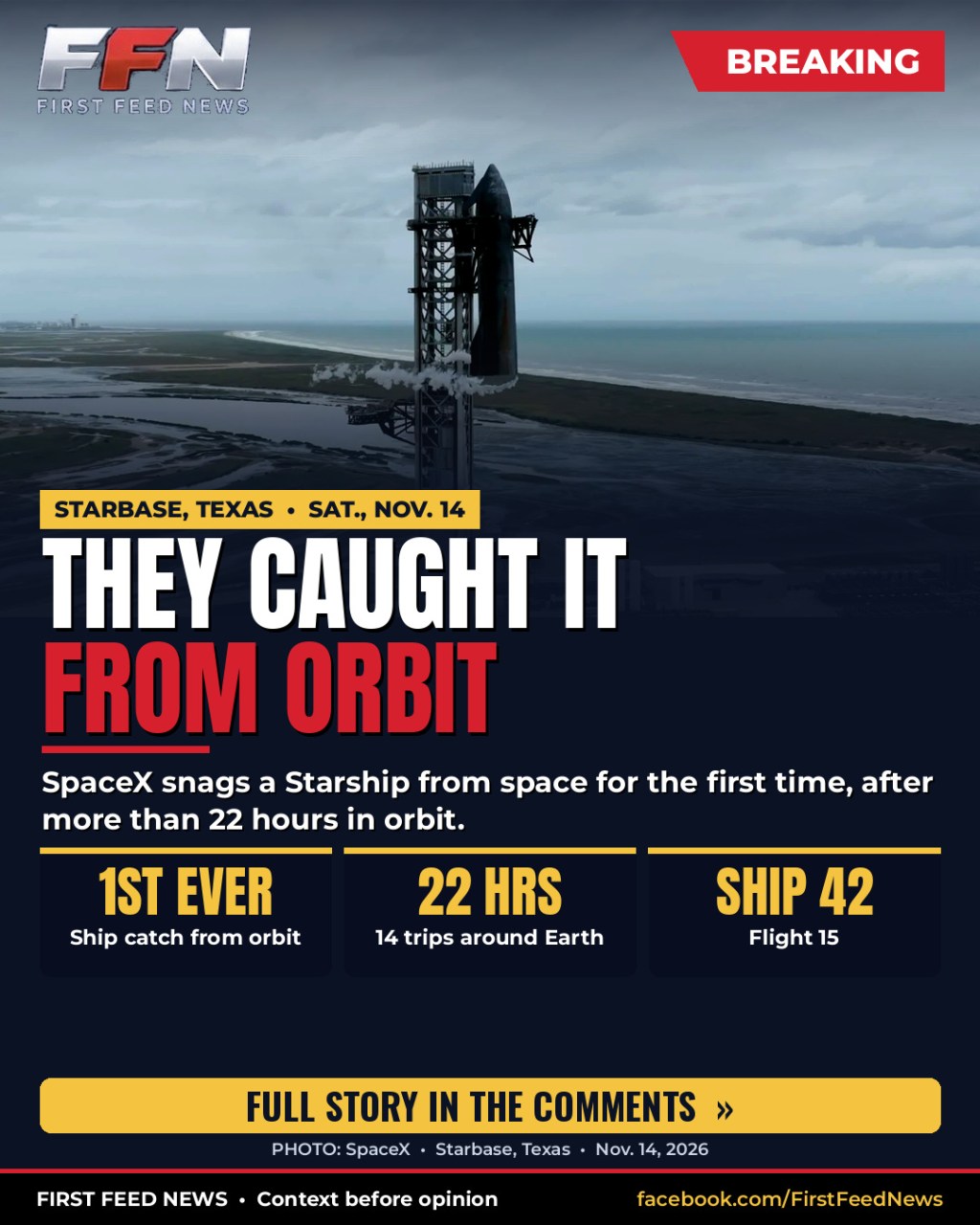
At about 4:20 p.m. Eastern on Saturday, Nov. 14, the launch tower’s mechanical arms at Starbase, Texas, caught Ship 42 after more than 22 hours in orbit, according to SpaceX, the Associated Press, CNBC, Space.com and the BBC. Friday’s Super Heavy booster catch was aborted, and that booster exploded in the Gulf.
What happened
At about 4:20 p.m. Eastern on Saturday, Nov. 14, SpaceX caught the upper stage of Starship — the “ship,” Ship 42 — with the mechanical “chopstick” arms of the launch tower at Starbase, Texas. SpaceX, the Associated Press, CNBC, Space.com and the BBC all confirmed the catch. Space.com timed the historic moment at about 4:20 p.m. Eastern, matching SpaceX’s Flight 15 timeline of 22 hours, 32 minutes and 34 seconds after Friday’s 5:47 p.m. ET liftoff (about 4:19 p.m. Eastern). This is the first time SpaceX has caught a Starship from orbit. The company has caught Super Heavy boosters on earlier flights, but never the ship.
The webcast line
On SpaceX’s landing webcast, spokesman Dan Huot called the catch “the missing link” and “the holy grail of space flight, plummeting through fire to be snatched out of the air by steel,” adding, “We caught a Starship, and now everything changes.” That quote is from Space.com’s live coverage of the webcast.
Friday’s booster explosion is a separate story
Flight 15 lifted off from Starbase at 5:47 p.m. ET on Friday, Nov. 13. The plan was to catch both stages — the booster minutes after liftoff, and the ship about 22 and a half hours later. The booster catch failed. SpaceX aborted it and diverted Booster 22 to the Gulf of Mexico, where it exploded just above the water. On Saturday’s webcast, SpaceX’s Kate Tice said early indications are that the booster ended its boostback burn early because of a low-fuel-mass alarm, then guidance detected it was not in the right position and correctly aborted to an offshore divert. She said the team is still investigating the root cause. The successful ship catch does not, by itself, explain what went wrong with the booster.
The flight that led here
The ship reached orbit, only the second time Starship has done that, and deployed all 26 Starlink V3 satellites, SpaceX said. It flew about 14 orbits over more than 22 hours. Before the catch, SpaceX’s Kate Tice said all teams had polled “go,” including the heat shield, flaps, guidance and the tower.
What’s still true
SpaceX wants a fully reusable orbital system. Saturday’s catch is a major step. It is not a complete two-stage recovery on this flight, because Friday’s booster was not caught.
Sources: SpaceX Flight 15 webcast and official posts, Associated Press, CNBC, Space.com, BBC
Watch the video on our Facebook page. Follow First Feed News for breaking news first.






Leave a Reply