
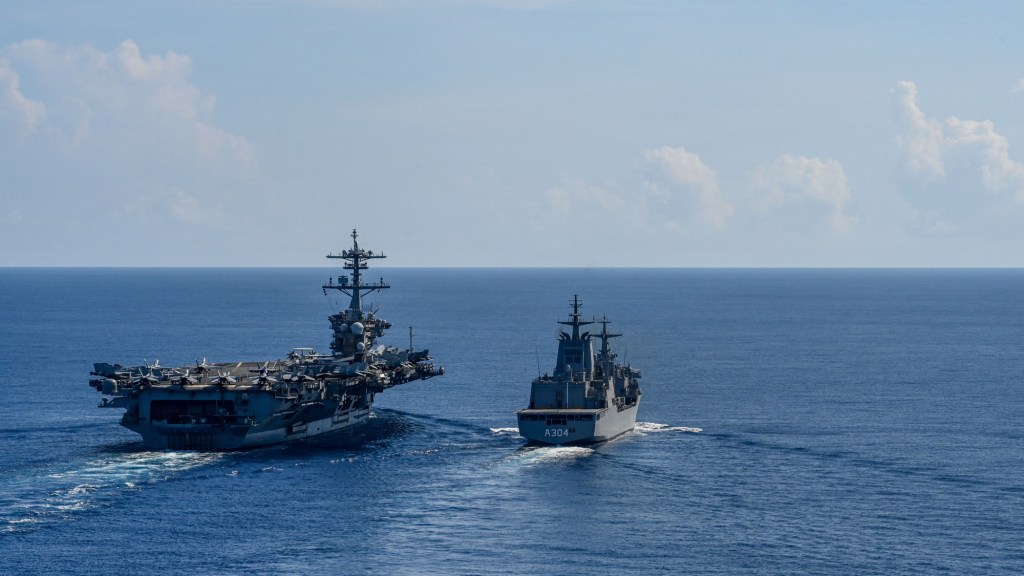
U.S. officials said the USS Theodore Roosevelt entered the Middle East on Sunday, putting three American aircraft carriers in the region at once. The Pentagon and U.S. Central Command have not formally confirmed the arrival. The two carriers already on station have no announced departure dates.
A third carrier, still unofficial
A U.S. official told Al Jazeera on Monday, Nov. 16, that the nuclear-powered aircraft carrier USS Theodore Roosevelt had arrived in the Middle East, joining two other carrier strike groups in the U.S. Central Command area of responsibility. Unnamed officials gave the same account to Axios, The Wall Street Journal, The National, Al-Monitor and the Associated Press, placing the arrival on Sunday, Nov. 15.
The Pentagon and CENTCOM have not issued a formal confirmation. Stars and Stripes, Fox News and Anadolu Agency all reported that CENTCOM did not immediately respond to requests for comment. The most recent U.S. Naval Institute News Fleet and Marine Tracker, dated Nov. 9, still placed the Roosevelt in the Indian Ocean after a Singapore port call, heading toward CENTCOM — consistent with a mid-November arrival, but not a confirmation of it.
Al-Monitor, citing a U.S. official, said the ship reached the western Arabian Sea overnight into Monday. That more precise location has not been independently confirmed. Entering CENTCOM’s area, which covers the Middle East and surrounding waters, does not by itself establish where the strike group will operate or for how long.
The Roosevelt, flagship of Carrier Strike Group 9, left its San Diego home port on Sept. 27, according to Anadolu Agency and other reports citing U.S. officials. It trained in the Western Pacific during exercise Keen Sword 27, visited Singapore in early November, then transited the Malacca Strait into the Indian Ocean, USNI News reported. Stars and Stripes, citing the strike group’s makeup, said it is sailing with Carrier Air Wing 11, the cruiser USS Chosin, and the destroyers USS Decatur and USS Paul Hamilton. The air wing includes F-35C stealth fighters and F/A-18 Super Hornets.
The two already there
The Roosevelt joins the USS George Washington and the USS George H.W. Bush, both already operating in the Arabian Sea, according to the Nov. 9 USNI tracker and multiple arrival reports.
The Bush left Naval Station Norfolk on March 31 and entered the CENTCOM area on April 23, CENTCOM said at the time, relieving the USS Gerald R. Ford. That is about 7½ months away from home and nearly seven months in the region. Families were originally told to expect a standard six- to seven-month deployment. The strike group has already been extended twice, according to reporting on a Nov. 9 town hall at Norfolk. Acting Navy Secretary Hung Cao, Fleet Forces commander Adm. Karl Thomas and other Navy leaders told families the ship would not be home for the holidays and to prepare for a worst-case deployment of about 12 months, into March 2027, MS NOW, Military Times and WAVY reported. Thomas said the holiday extension was so recent it was not yet in the official orders book. The Navy later declined to answer Stars and Stripes’ questions about an extension, citing operational security. Vice Chief of Naval Operations Adm. James Kilby told families the final call rests with Defense Secretary Pete Hegseth, according to that reporting. Asked what would bring the strike group home, Cao said the criteria was for Iran “to agree to a non-nuclear Iran.”
The George Washington, a Japan-based carrier, left Yokosuka on May 10, Stars and Stripes reported, and entered the CENTCOM area on Aug. 19, which CENTCOM announced, relieving the USS Abraham Lincoln. That is about six months out of Japan and three months in the Middle East. USNI News and The National have described the Roosevelt as the ship expected to relieve the George Washington. Al-Monitor has said the Roosevelt was originally expected to replace the Bush. Reuters, as cited by Gulf Business and The Jerusalem Post, reported before the arrival that a third carrier was moving in to replace one of the two already there, but that all three could remain if required. Neither the Bush nor the George Washington has an announced departure date.
The overlap is the question
A three-carrier presence is unusual. It is also not, by itself, proof that new strikes are coming. Recent MidEast carrier handoffs have been short. When the George Washington arrived on Aug. 19, USNI News and Stars and Stripes reported the Abraham Lincoln leaving the region by Aug. 22, an overlap of only a few days. In April, when the Bush arrived and created the first three-carrier MidEast presence since the 2003 Iraq War, the Ford headed home about a week later, around May 1, according to contemporaneous reports.
This time looks different in one important respect: the Bush is not being described as on its way out, and the George Washington has not been formally relieved. If this is only a standard turnover, the three-ship window could close in a matter of days or a couple of weeks. If both of the carriers already in the region stay, the United States would be keeping its heaviest carrier force of the Iran war on station through the holidays and potentially longer. Officials have not said which it will be.
That uncertainty raises the question of timing. If Washington intends to use this force against Iran, the overlap — while all three air wings are in theater at once — is the period when it would have the most carrier-based combat power available. Past buildups have sometimes preceded or accompanied major operations: five U.S. carriers were in the region for the 2003 invasion of Iraq, according to Steven Wills of the Center for Maritime Strategy; a two-carrier overlap was in place in June 2025 around the U.S. strikes on Iranian nuclear sites; and CENTCOM publicly advertised a three-carrier presence in April 2026 during Operation Epic Fury, months into the current war. History poses the question. It does not answer it. A three-carrier arrival can also be a relief, a deterrent, or insurance for the oil blockade.
Mixed signals from Washington
President Donald Trump has sent conflicting messages about whether the fighting will resume. After meeting Qatar’s prime minister last week, he said a resumption of strikes was “quite unlikely” and that the military component of the war was “effectively over,” while adding that U.S. forces remain “locked and loaded” if conditions change, Al Jazeera reported. On Truth Social, he also wrote: “We don’t need a deal with Iran. Those days have long since passed. We’ve got their money, Hundreds of Billions of Dollars, and we’ve got their Strait!”
Secretary of State Marco Rubio has said the economic pressure campaign is working and that a return to large-scale military operations is likely unnecessary, according to Al Jazeera. The U.S. military recently dismissed an Israeli media report that it was preparing to resume operations against Iran as “pure speculation,” Anadolu Agency reported.
The naval buildup is already being used for the blockade. CENTCOM said earlier this month that U.S. forces have turned away 150 commercial ships and disabled five others, blocking Tehran from exporting more than $30 billion in crude oil, Stars and Stripes reported.
Iran keeps firing
The Roosevelt’s arrival was reported on the same day Iran launched drones at the Riffa helicopter base in Bahrain, the first such attack on the island nation since early September, Stars and Stripes and The National reported. Manama hosts U.S. Naval Forces Central Command and the U.S. Fifth Fleet; Riffa is about 11 miles from that installation. Bahrain said it intercepted projectiles. The Islamic Revolutionary Guard Corps claimed a “successful impact.”
Attacks on commercial shipping in and near the Strait of Hormuz have also climbed, with at least 14 this month after 35 in October, according to data from the U.K. Maritime Operations Center and the International Maritime Organization cited by Stars and Stripes.
Iranian Deputy Foreign Minister Kazem Gharibabadi said Iran “will not wait for the U.S. to attack first” and that “Iran is not Cuba that you can blockade, nor is it Venezuela that you can force to surrender,” in remarks carried by Iranian state media and reported by Al Jazeera. Foreign Minister Abbas Araghchi, speaking in Islamabad, warned that U.S. and Israeli attacks threaten regional energy security.
Ali Vaez of the International Crisis Group told Al Jazeera that both sides are caught in a “perilous game of chicken,” convinced that striking first may be safer than waiting to be struck, and that “their efforts to deter another war could inadvertently ignite one.” Bilal Saab of Chatham House wrote last week that, “if history is any guide, Iran will at some point resort to violence to try to force Washington to reconsider.”
What three carriers have meant before
This would be the second time this year the United States has had three carriers in the Middle East, not the first since 2003. In April, CENTCOM announced that the Bush, the Abraham Lincoln and the Gerald R. Ford were operating there “for the first time in decades,” a presence that lasted about a week before the Ford departed. The last comparable concentration before that was the 2003 Iraq campaign, when the U.S. actually had five carriers in the theater, Wills told Stars and Stripes. A three-carrier overlap in January 2012 was brief and was a relief, not a sustained combat posture, the Navy later told Breaking Defense.
Navy leaders have been warning that long deployments are now the norm. The service’s traditional target is about seven months, or 210 days. Chief of Naval Operations Adm. Daryl Caudle and Master Chief Petty Officer of the Navy John Perryman said in late October that sailors should expect 10- to 11-month deployments for the next couple of years, USNI News reported. The Ford’s last deployment ran 326 days. The Lincoln’s ran 321. The next East Coast carrier often mentioned in rotation, the USS Dwight D. Eisenhower, was in the Norfolk area in early November, according to the USNI tracker, and has been described as still in its training cycle, with a deployment not expected until the first half of 2027. No official relief date for the Bush or the George Washington has been announced.
The open question is not whether a third carrier has shown up. Officials in several newsrooms say it has. The question is whether Washington is rotating ships — or holding a three-carrier force in place for whatever comes next.
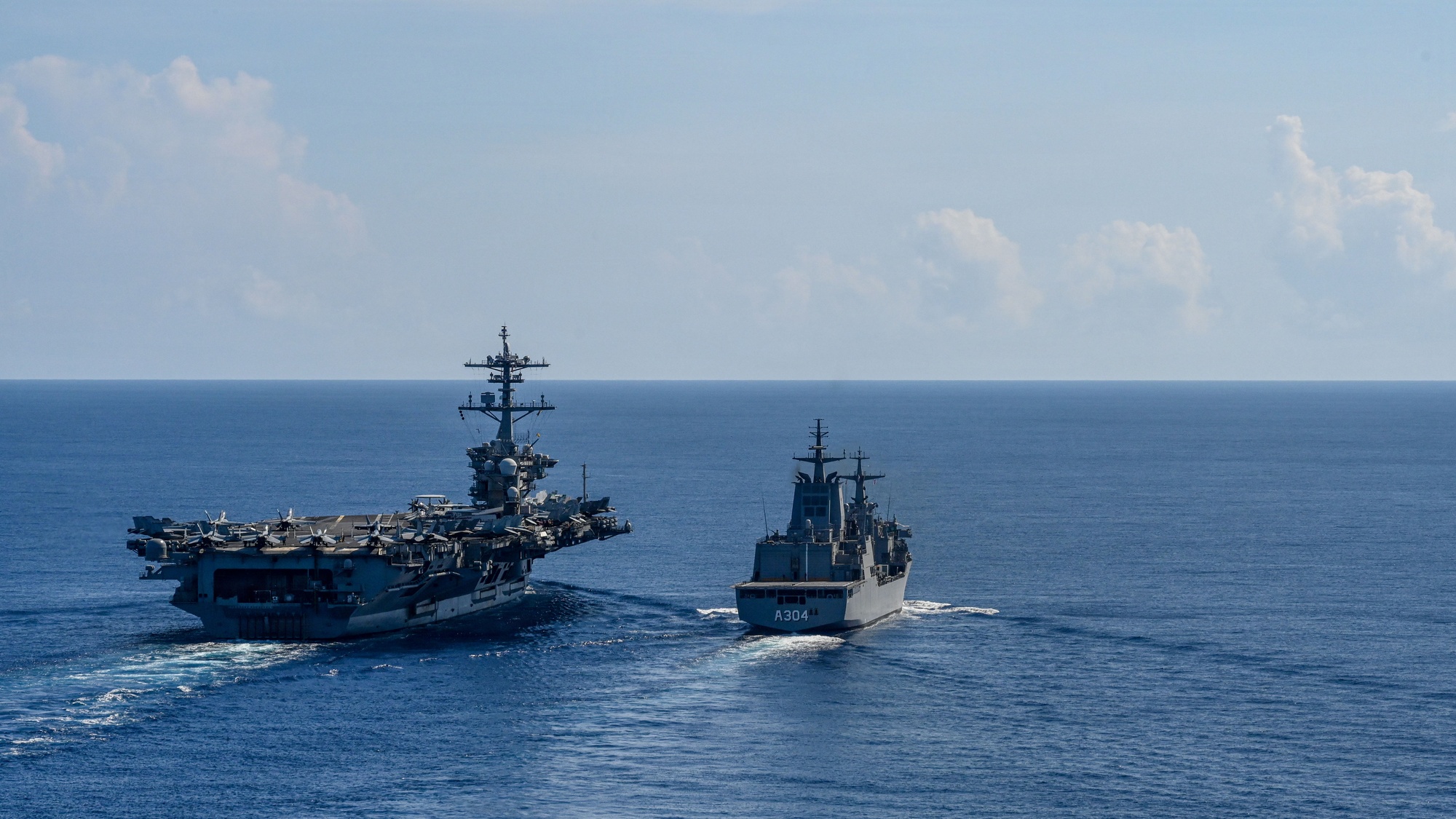
Sources: Al Jazeera, Associated Press, Axios, The Wall Street Journal, Stars and Stripes, The National, Al-Monitor, USNI News Fleet and Marine Tracker, Fox News, Anadolu Agency, Reuters (as cited by Gulf Business and The Jerusalem Post), MS NOW, Military Times, WAVY, Breaking Defense. Photo: U.S. Navy, Nov. 4, 2026, public domain. The photograph was taken in the U.S. 7th Fleet area during the Roosevelt’s transit, not in the Middle East.










Leave a Reply