
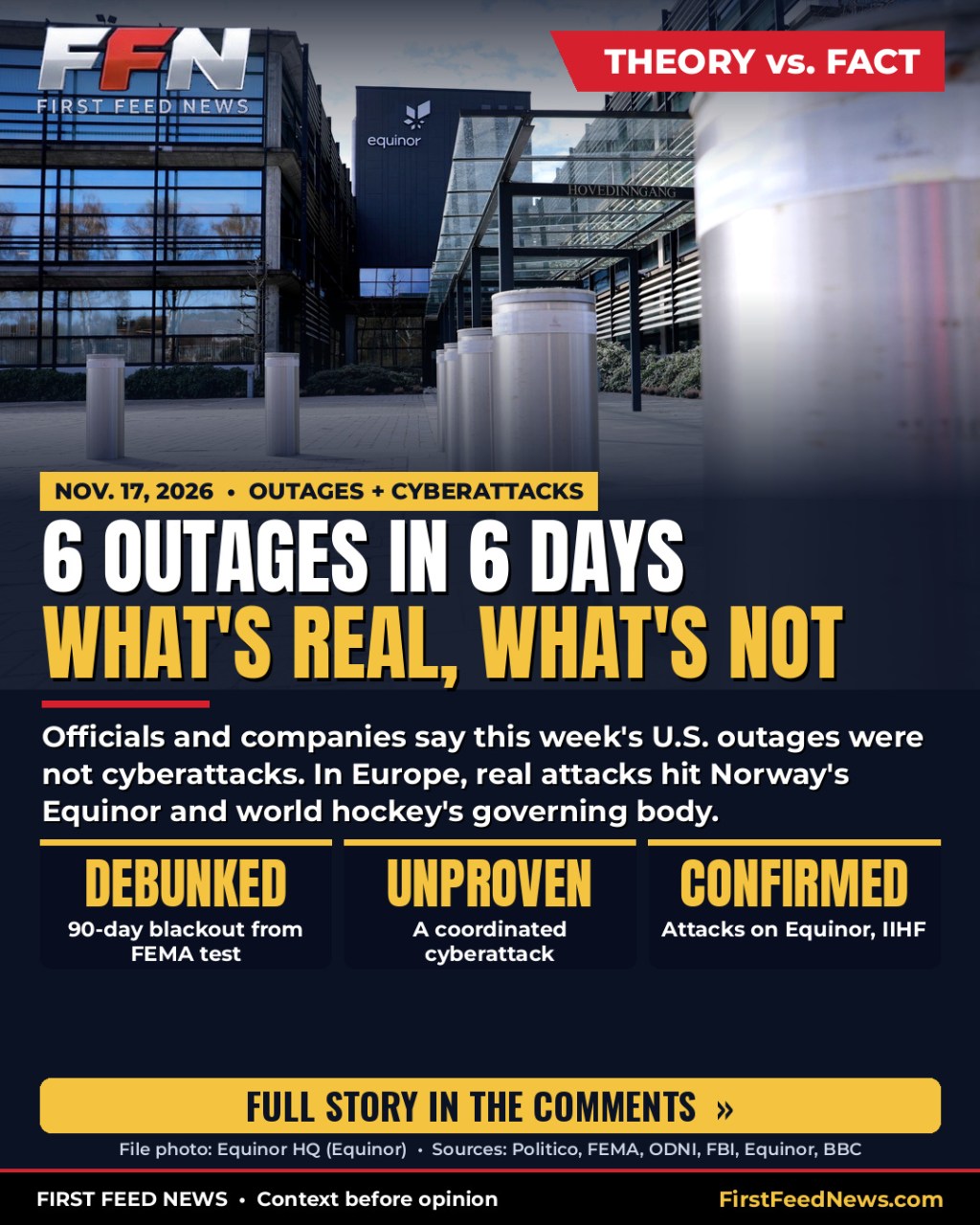
Six major outages in six days, by Politico‘s count, have set off a wave of online theories: a government blackout, a coordinated cyberattack, a hacked spy agency, even rogue artificial intelligence. Every agency and company involved has denied a cyberattack, and Politico reports there is no public evidence linking the outages. Meanwhile, in Europe, real cyberattacks were confirmed Tuesday at Norway’s Equinor, world hockey’s governing body and a German hospital.
Here is what people are claiming, what the record shows, and our verdict on each.
The six outages
Microsoft Outlook went down Nov. 12; Microsoft traced it to “an earlier network capacity upgrade,” the Associated Press reported. The FAA’s nationwide ground stop followed Nov. 13; the FAA said its legacy equipment became unstable when data flooded its network, pointed to sites where its provider had been deploying a new router, and said it has “no indication that this was a cyberattack or an outside nefarious actor.” On Nov. 16, a software bug slowed JPMorgan Chase transactions and a technology issue delayed United Airlines flights, Politico reported; United said there was “no indication that this was a cybersecurity-related issue,” according to CBC News. On Tuesday, the NSA’s internal network and Apple services went down; the NSA cited routine maintenance and Apple blamed an internal update.
Theory 1: FEMA’s alert test would trigger a 90-day blackout
Verdict: DEBUNKED
The claim: Posts on TikTok and other platforms said Tuesday’s nationwide Emergency Alert System test would start a 90-day power or internet blackout, USA Today and Snopes reported.
The facts: FEMA and the FCC announced the test in September; federal law requires one at least every three years. FEMA posted Monday: “No blackouts, no secret emergencies.” The test aired around 2:20 p.m. ET and lasted under a minute, and a Department of Homeland Security official told CNN it went smoothly. The New York Post and Radio World also reported it ran as planned. PolitiFact rated the blackout claim False and found that a viral video used to promote it had been manipulated.
Theory 2: It’s a coordinated or state-sponsored cyberattack
Verdict: UNPROVEN
The claim: The string of failures is too big to be a coincidence and must be a coordinated attack, possibly by a foreign government.
The facts: Director of National Intelligence Jay Clayton told Fox Business on Tuesday: “We do not see the indicia of a coordinated cyberattack — let me just be clear about that — and we do not see the indicia of state-sponsored activity here,” Just The News reported. Each company and agency has given a technical cause, and Politico reports there is no public evidence linking the outages. No official has offered evidence of an attack.
Theory 3: The NSA was hacked
Verdict: UNPROVEN
The claim: The disruption on the National Security Agency’s internal network was a breach.
The facts: The NSA said its internal networks were affected by “routine maintenance” and that mission-critical capabilities remained operational, according to Politico. Officials told CBS News, NBC News and The Washington Post they had no evidence it was a cyberattack. There is no public evidence of a hack.
Theory 4: The FBI just issued a new AI-hacking warning tied to the outages
Verdict: DEBUNKED
The claim: On Tuesday, the FBI’s Dallas office posted that “cybercriminals and state-aligned hackers are exploiting ARTEX,” an AI-powered penetration-testing framework, The Dallas Morning News and Just The News reported, and the post spread as a new warning amid the outages.
The facts: The FBI’s main account responded: “This FBI Cyber advisory on ARTEX was released last Friday, 11/13. It is not a new announcement, and the FBI has not issued any additional warning since. The guidance in the advisory remains current.” An FBI official told ABC News ARTEX does not appear to have any connection to the recent problems, including the NSA network, the Chase banking outages, the Optimizely malware reports, the FAA ground stop and the Outlook outage.
The threat itself is real. The FBI’s Nov. 13 FLASH advisory says a variety of malicious cyber actors have used ARTEX since at least August against organizations worldwide, with some intrusions reaching privileged access in under three hours. It cites attacks on South Korean financial institutions that exposed personal information of about 67,000 people, and a supply-chain compromise of ConnectWise Cloud Backup customers.
Theory 5: Rogue AI is behind the outages
Verdict: UNPROVEN
The claim: Runaway artificial intelligence systems are knocking out older infrastructure.
The facts: Microsoft said its outage was not the result of a cyberattack or rogue AI agents, CBC News reported, and the AP reported the companies and agencies involved have denied that rogue AI systems were to blame. Homeland Security Secretary Markwayne Mullin told Fox News an unnamed technology expert had raised the idea, but he offered no evidence.
Confirmed: Real cyberattacks in Europe
Equinor. Norway’s Equinor, Europe’s largest gas supplier, said Tuesday it “has detected an ongoing cyber-attack against certain IT systems.” “There are no indications that data has been stolen. The attack has not affected Equinor’s operations and production,” the company said in a statement, adding that authorities were being informed. A person at the company told Reuters that Equinor’s internal email system was down, and Norway’s National Security Authority said it was “providing assistance as needed.”
World hockey’s governing body. The International Ice Hockey Federation confirmed it was “the target of a cyber attack,” and its website has been offline since Tuesday morning. Visitors Tuesday morning saw an image of Russian players with the headline “Scared to face Russia?”, the BBC reported, days after the IIHF confirmed Russia would not compete at next month’s world junior championship in Alberta. CBC News said it could not confirm the image. The Russian Ice Hockey Federation said it views such actions negatively and considers unlawful methods unacceptable, the BBC reported.
A German hospital. The emergency room at the Greiz-Ronneburg district hospital in Thuringia is taking patients again after a hacker attack detected Sunday morning, dpa reported. The county said the attack was an extortion attempt, according to MDR; state criminal police and prosecutors are investigating, the Greiz district said.
Authorities have not linked the European attacks to each other or to the U.S. outages.
Sources
- Politico
- Associated Press
- FAA
- CBC News (outages)
- USA Today
- CNN via Channel3000
- New York Post
- Radio World
- PolitiFact
- Snopes
- Just The News (DNI Clayton)
- Just The News (FBI)
- The Dallas Morning News
- ABC News
- FBI FLASH advisory (IC3)
- Equinor
- Reuters via CNA
- CBC News (IIHF)
- BBC Sport
- Landkreis Greiz
- MDR
- dpa via n-tv
Video and card: First Feed News. Images: FEMA, ODNI, NSA and FBI seals (public domain); Equinor press photo; IIHF.com screengrab via CBC News; Apple System Status screenshot.





Leave a Reply