
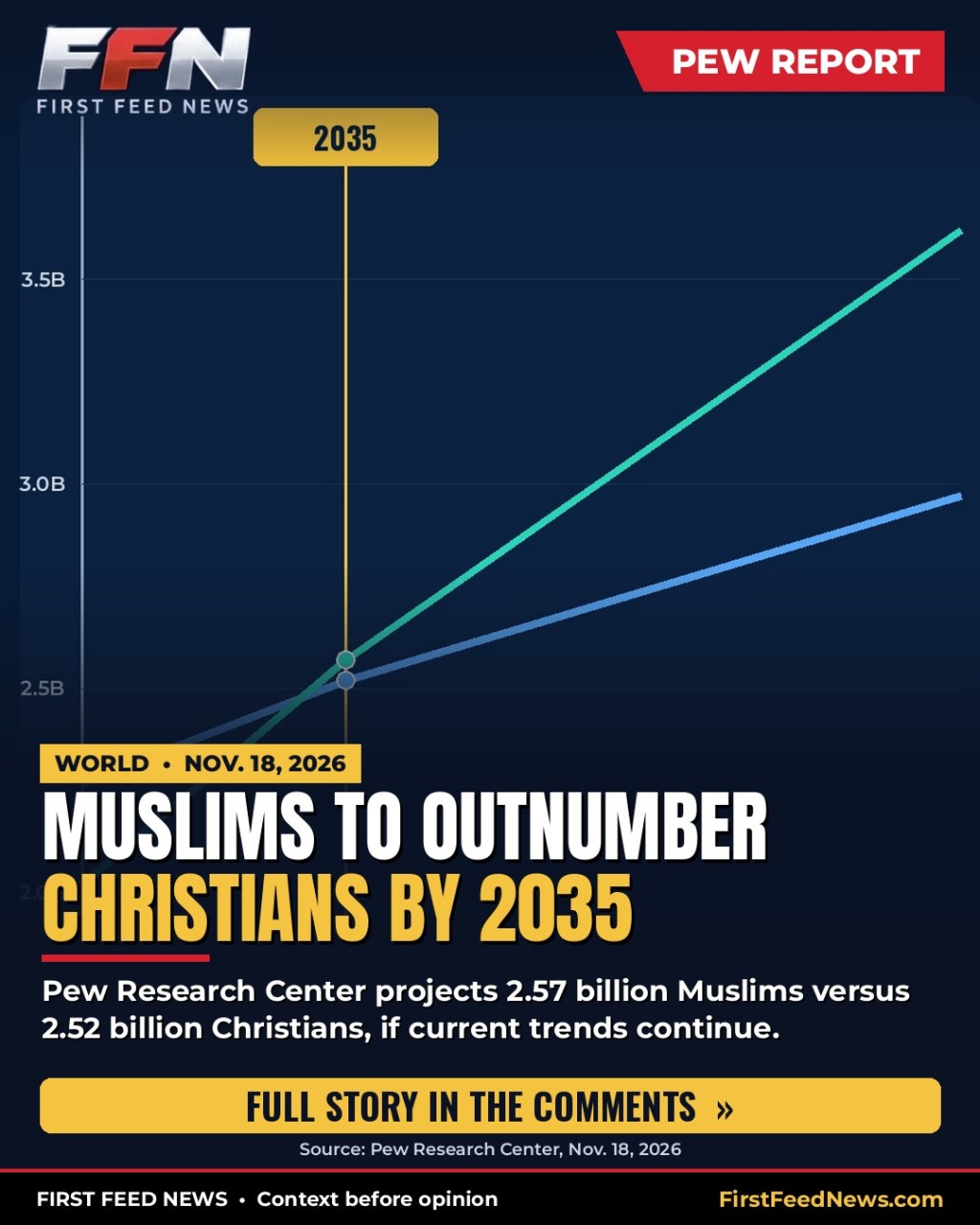
Pew Research Center now projects that Muslims will outnumber Christians worldwide by 2035, about 2.57 billion to 2.52 billion, if current trends continue. Pew’s last such projection, in 2015, had put that crossover around 2070.
For centuries, Christianity has been the world’s largest religion. A new Pew Research Center report, released Wednesday, says that may soon change. Pew projects Muslims will become the larger group by 2035 — 2.57 billion Muslims versus 2.52 billion Christians. In 2020, the baseline year for the study, Christians still led, 2.27 billion to 2.02 billion Muslims.
Both faiths keep growing
The shift is not because Christianity is shrinking worldwide. Both groups are projected to keep adding people. Pew says the world’s population will grow about 29 percent between 2020 and 2070, with Christians growing about 30 percent and Muslims about 80 percent. By 2070, if recent trends continue, there will be more than 3.6 billion Muslims and just under 3 billion Christians. Muslims would then make up about 36 percent of the world, up from 26 percent in 2020. Christians would hold fairly steady at about 29 percent.
That timeline is much sooner than Pew’s previous outlook. In a 2015 study based on 2010 data, Pew’s main projections stopped at 2050, when Muslims and Christians were expected to be nearly even. An extension of that model put a crossover around 2070. The new report, using a 2020 baseline, moves that date up by about 35 years, to 2035.
Births, not conversions
Pew says the main driver is births. In the 2020-2025 period, Muslim women had about 3.1 children on average, compared with 2.5 for Christian women and 1.6 for all other women combined. A generation typically replaces itself at about 2.1 children per woman. Between 2020 and 2070, Muslims are projected to gain 1.6 billion people through natural population change — births minus deaths — compared with 792 million for Christians.
Religious switching also matters, though less than fertility. Pew projects Muslims will see a net loss of 8 million people from people leaving or joining the faith over the period. For Christians, the net loss is 105 million, most of them becoming religiously unaffiliated. Movement between Islam and Christianity is projected to roughly even out: 9.2 million Muslims becoming Christian, and 9 million Christians becoming Muslim. In other words, Pew does not attribute Islam’s projected growth to converts from Christianity.
Congo is projected to pass the United States
Pew also projects a change in which country has the most Christians. The United States had the world’s largest Christian population in 2020, at 217 million. That number is projected to fall to 174 million by 2070, the largest decline of any country. In the Democratic Republic of the Congo, the Christian population is projected to triple, from 92 million in 2020 to 299 million in 2070, passing the United States.
That is a projection about the largest number of Christians, not the most Christian country by share of the population. Pew is not saying Congo will be more heavily Christian than the United States as a percentage of residents.
Christians lose a U.S. majority, but stay the largest group
In the United States, Pew projects Christians will fall from 64 percent of the population in 2020 to 48 percent in 2070, dropping below a majority by 2065. They are still projected to remain the largest religious group. Religiously unaffiliated people, or “nones,” are projected to rise from 30 percent of U.S. residents in 2020 to 41 percent in 2070. Pew says 10 countries that had a Christian majority in 2020 will no longer have one by 2070, including the United States.
What the projections are, and are not
Pew is careful to describe these figures as projections if current demographic trends continue — age profiles, fertility, mortality, migration and religious switching. The report is not a prediction of wars, disasters, political change or sudden religious revivals, any of which could move the numbers. Associated Press and Deutsche Welle also reported the 2035 crossover from the same Pew study.
Sources: Pew Research Center, “The Future of World Religions: Population Growth Projections, 2020-2070,” Nov. 18, 2026, and accompanying short read and regional chapters; Pew Research Center, “The Future of World Religions: Population Growth Projections, 2010-2050,” April 2, 2015; Associated Press; Deutsche Welle.
Follow First Feed News on Facebook for breaking news first.








Leave a Reply