
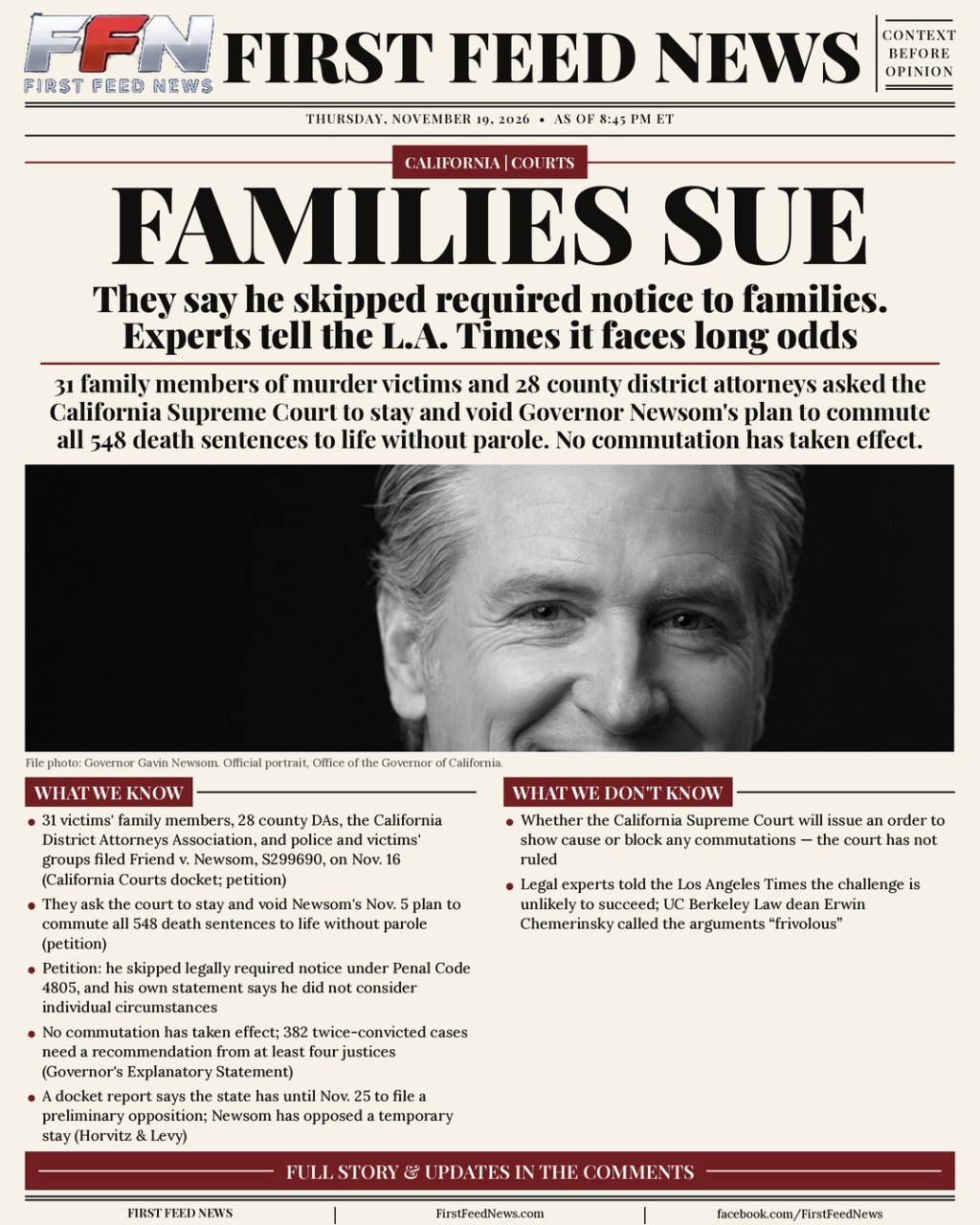
Victims’ families and prosecutors have asked California’s Supreme Court to stop Governor Gavin Newsom from commuting all 548 death sentences to life without the possibility of parole. Legal experts told the Los Angeles Times the challenge faces long odds. No commutation has taken effect.
First Feed News video report is below. After it is posted on Facebook, we will add the Reel link here.
The petition
The case is Friend v. Newsom, California Supreme Court No. S299690, filed November 16, according to the court’s new-case listing. The petition, dated November 15, is brought by 31 family members of murder victims — including Marc Klaas, the father of 12-year-old Polly Klaas — along with 28 county district attorneys, the California District Attorneys Association, the Peace Officers Research Association of California, and victims’ advocacy groups.
Some news accounts said 30 county prosecutors. The petition’s own parties list names 28 county district attorneys, plus the statewide prosecutors’ association.
They ask the court to immediately stay any commutation and to declare void any mass grants made without the notice and individualized process they say the law requires.
What the families and prosecutors argue
The petition says that since Penal Code section 4805 was enacted in 2011, “a Governor can no longer legally commute a sentence without affording the victims of the crimes at issue an opportunity to be heard.” The families and prosecutors say Newsom skipped that legally required notice to district attorneys and to victims’ families, and that he did not review the cases one by one.
Anne Marie Schubert, president and CEO of the Criminal Justice Legal Foundation, said in a November 16 statement: “This lawsuit is about protecting the constitutional rights of victims, defending the rule of law, and ensuring that no Governor is above the law.” She added that blanket commutation “is not an exercise of discretion — it is an abandonment of it.”
What Newsom says
On November 5, Newsom announced, “I have decided to exercise my constitutional clemency authority to commute all California death sentences to life without the possibility of parole.” In his open letter he said “state-sanctioned killing is incompatible with California’s values.” A governor’s fact sheet says the action does not release anyone, make anyone eligible for parole, change the underlying convictions, or erase restitution orders.
In his official Explanatory Statement to the court, Newsom wrote that “the Governor’s authority to grant clemency does not depend on the existence of an application,” and that he “did not consider information about their individual circumstances, apart from the facts that a death sentence was imposed in their cases and they have more than one felony conviction.” He asked the court to recommend clemency for the 382 condemned persons with more than one felony conviction, as required by article V, section 8 of the California Constitution.
Where the case stands
No commutation has taken effect. A docket report by the appellate firm Horvitz & Levy says the California Supreme Court has asked the state to file a preliminary opposition by November 25, and that the governor has opposed a temporary stay.
Legal experts told the Los Angeles Times the challenge faces long odds. Erwin Chemerinsky, dean of U.C. Berkeley Law, called the arguments “frivolous” and said, “If we just focus on the law, it’s clear that Gov. Newsom has the authority to commute these sentences in this way.” The court has not ruled.
Sources: Petition for Writ of Mandate, Friend v. Newsom, California Supreme Court No. S299690, filed Nov. 16, 2026; California Courts new-case listing; Governor’s Explanatory Statement and fact sheet, Nov. 5, 2026; Criminal Justice Legal Foundation / California District Attorneys Association statement, Nov. 16; Horvitz & Levy docket reports, Nov. 16–17; Los Angeles Times, Nov. 19; Metropolitan News-Enterprise; New York Post. Photo: official portrait, Office of the Governor of California.







Leave a Reply