
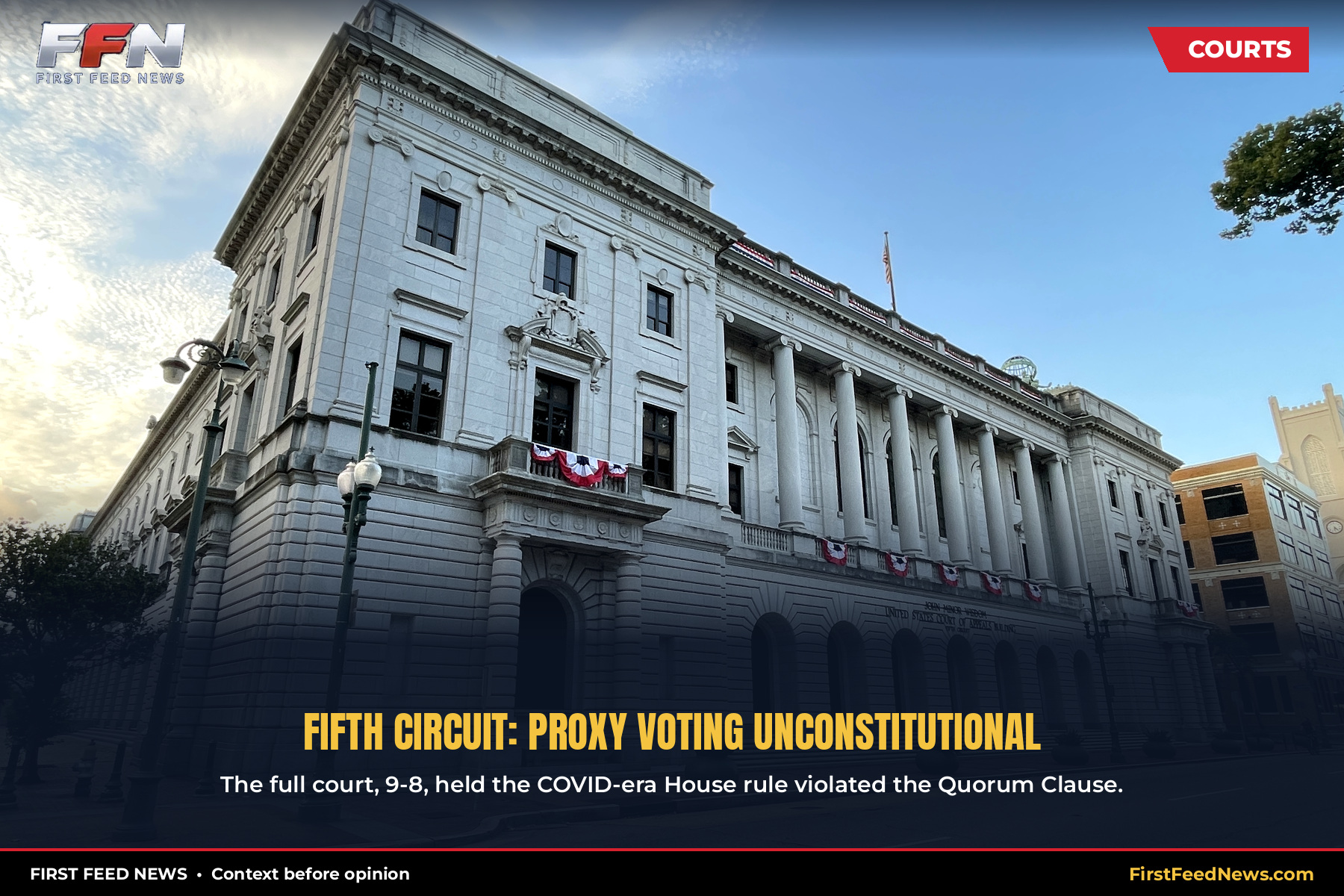
The full U.S. Court of Appeals for the Fifth Circuit ruled Friday that the House of Representatives’ COVID-era proxy-presence rule violated the Constitution’s Quorum Clause.
In Texas v. Blanche, No. 24-10386, the en banc court divided 9-8 and affirmed a Northern District of Texas injunction. Judge Cory Wilson, writing for the majority, said “Proxy presence does not count.” “While the chambers of the legislature have much discretion regarding their rules of procedure, the Quorum Clause’s constraints on congressional power cannot be circumvented by congressional fiat,” he wrote. The opinion was filed Nov. 20, 2026, and is posted on the Fifth Circuit’s website.
Wilson was joined by Chief Judge Elrod and Judges Jones, Smith, Willett, Ho, Duncan, Engelhardt, and Oldham.
The 2022 vote
The House adopted the proxy rule in House Resolution 965 in 2020, in the early months of the COVID-19 pandemic, and later carried it forward in House Resolution 8. Under that rule, a member could designate another member to record his or her presence and cast his or her vote.
The House used the rule on Dec. 23, 2022, when it passed the Consolidated Appropriations Act of 2023, the December 2022 omnibus spending bill. The Congressional Record tally, recited in the opinion, was 225 yeas, 201 nays, one member voting present, and four not voting. Of the members who recorded a vote, 226 recorded their presence and their vote by proxy, the court said, so less than a majority of the 435-member House was physically present. A House quorum is 218. The Senate then passed the bill, and President Joe Biden signed it into law as Public Law 117-328. Reuters and the dissenting opinion describe the package as a $1.7 trillion government funding bill.
During the vote, Rep. Chip Roy of Texas said the bill was “moving off the floor without a physical quorum present” and reserved the right to object, the opinion recounts. The Speaker pro tempore answered that members recording their presence by proxy were counted for a quorum under House Resolution 8. Reuters reported that the proxy rule was later dropped after Republicans won the House.
What the court actually blocked
The State of Texas argued that because the proxy-presence rule is inconsistent with the Quorum Clause, the House did not validly pass the Act. Texas sought an injunction against only one portion of that law: the Pregnant Workers Fairness Act. The federal government argued that the enrolled-bill rule barred the court from reviewing how the bill was passed, and, alternatively, that the Quorum Clause allows proxy presence.
The Fifth Circuit held that the enrolled-bill rule did not bar review, because there is no factual dispute about the House’s use of proxies. It then held that the Act’s passage was unconstitutional: the Clause’s text, context, original understanding, and historical practice, the majority said, all indicate that members must be present for quorum purposes, “as the Supreme Court expressly held over 125 years ago.”
The practical relief, however, is narrow. The court affirmed only the district court’s injunction stopping the U.S. Department of Justice and the Equal Employment Opportunity Commission from enforcing the Pregnant Workers Fairness Act against Texas. The district court did not enjoin the rest of the omnibus, and Texas did not ask it to. The Fifth Circuit’s reasoning could be cited in later challenges to other provisions of the same bill, but Friday’s judgment does not strike down the entire spending package.
The dissent
Judge James Graves, joined by Judges Stewart, Richman, Southwick, Higginson, Douglas, and Ramirez, dissented. He said he could not agree with “their addition of a new requirement to the Quorum Clause,” and that the majority “read a physical-presence requirement into the quorum clause that does not exist.” Reuters quoted him calling the ruling “illogical, inexplicable, and invalid,” and questioning why, if the entire law was unconstitutionally passed, the relief “should be limited only to one small sliver of the multitrillion dollar bill.”
Judge Haynes also dissented, separately. A footnote to the majority opinion says she “does not think it is appropriate to throw out the Federal House of Representatives in this arena.”
The plaintiff
The plaintiff is the State of Texas. Reuters reported that Attorney General Ken Paxton’s office secured the original injunction. The caption names U.S. Attorney General Todd Wallace Blanche, in his official capacity, along with EEOC officials, the EEOC, and the Justice Department, as the defendants. Reuters said the Justice Department, which defended the law, and Paxton’s office did not immediately respond to requests for comment.
What we know
- The en banc Fifth Circuit ruled 9-8 on Nov. 20, 2026, in Texas v. Blanche, No. 24-10386, that the House’s COVID-era proxy-presence rule violated the Quorum Clause.
- The House used that rule to pass the Consolidated Appropriations Act of 2023 on Dec. 23, 2022, on a 225-201 vote, with 226 members recording their presence and vote by proxy, the opinion says.
- The court affirmed an injunction blocking enforcement of the Pregnant Workers Fairness Act against Texas only. It did not enjoin the rest of the spending bill.
What we don’t know
- Whether the Supreme Court will review the decision, or whether other plaintiffs will try to use the same reasoning against other parts of the 2022 omnibus.
- How the Justice Department will handle any further appeal.
Sources: Official opinion, Texas v. Blanche, No. 24-10386 (5th Cir. en banc Nov. 20, 2026), available at ca5.uscourts.gov; Congressional Record for Dec. 23, 2022, as cited in the opinion; Reuters, Nov. 20, 2026; Reason (Jonathan H. Adler), Nov. 20, 2026. Photo: Ktkvtsh / Wikimedia Commons, CC BY 4.0, June 28, 2026, John Minor Wisdom U.S. Courthouse, New Orleans.
Follow First Feed News on Facebook for breaking news first.






Leave a Reply