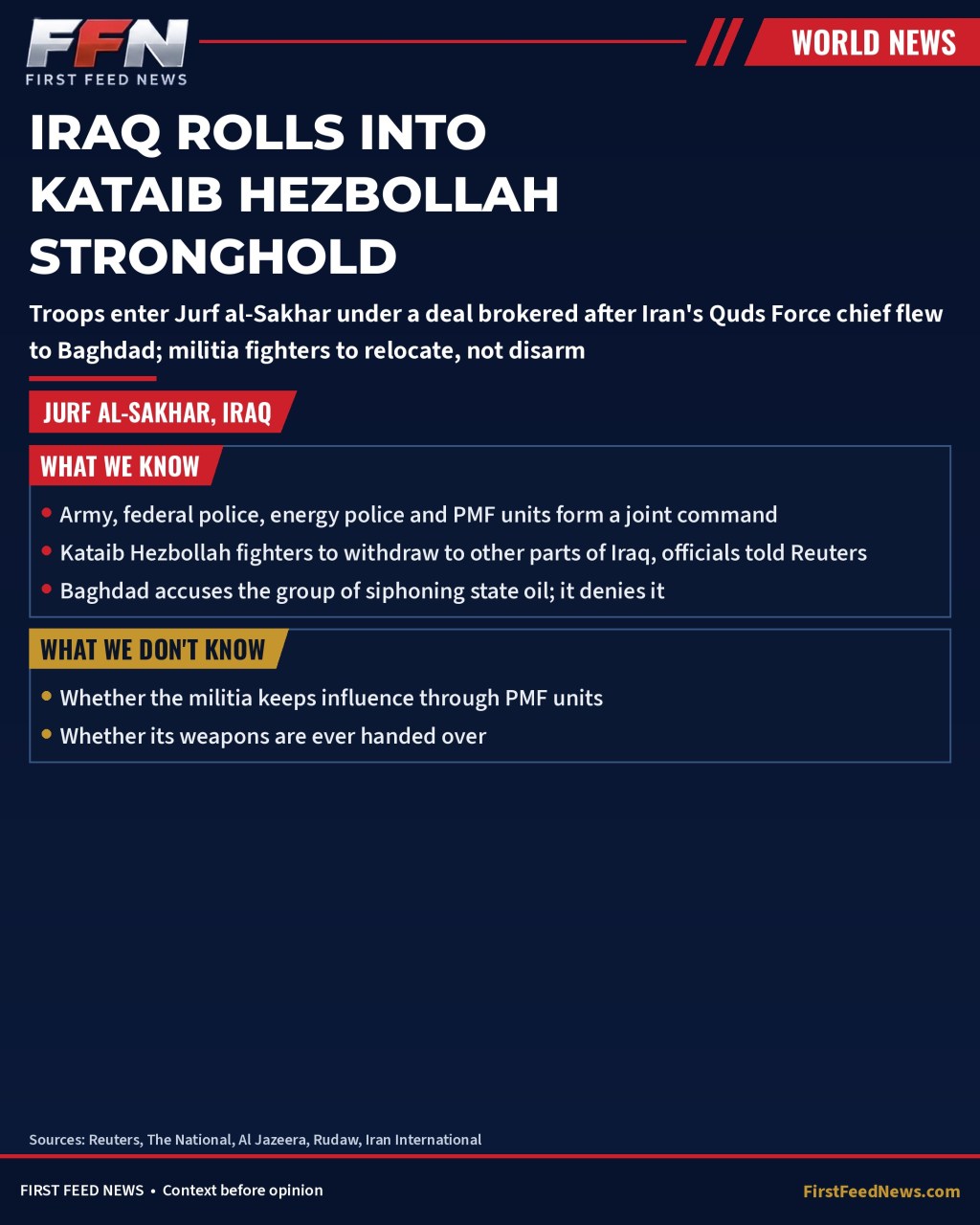
Iraq’s government is calling it a step toward restoring state authority. Critics are calling it a show. Iraqi forces began deploying Friday in Jurf al-Sakhar, a town south of Baghdad held for more than a decade by Kataib Hezbollah, Iran’s most powerful militia ally in Iraq, under a deal brokered by Shiite leaders days after the head of Iran’s Quds Force arrived in Baghdad, Iran International reported.
It was a compromise, not a raid. Under the deal, reached late Thursday, Kataib Hezbollah fighters are to withdraw to other parts of Iraq while federal police and the Popular Mobilization Forces take over parts of the area, Reuters and The National reported, citing security officials. “Kataib forces would move to other areas,” Lt. Gen. Saad Maan, head of Iraq’s Security Media Cell, told Reuters. Al Arabiya, citing sources, said the withdrawal would be phased over a month, according to Iran International.
Iran’s general in the room
Esmail Qaani, commander of Iran’s Revolutionary Guards’ Quds Force, arrived in Baghdad on Monday to help defuse the standoff, Iraqi Shiite political sources told Reuters. A Kataib Hezbollah spokesperson said the group’s secretary-general, Abu Hussein al-Hamidawi, met Qaani and Hadi al-Amiri, head of the Iran-aligned Badr Organization, in the talks that produced the deal, Reuters reported.
Hamidawi later told his fighters to resume normal duties but did not explicitly confirm the group would give up control of the area, Rudaw reported.
Troops move in
A convoy flying Iraqi flags drove toward the town Friday and hundreds of soldiers took up positions on the outskirts, while Kataib Hezbollah’s yellow flags were still flying farther inside and none of its fighters were visible, Iran International reported. The National reported tanks and armored vehicles rolling into the district.
“The deployment of forces and the handover of areas of responsibility are taking place starting today,” government spokesman Sabah al-Numan said Friday, according to The National. Maan said a joint command center began operating at 6 a.m. local time, the Energy Police had started securing oil pipelines, and a key road toward Karbala would reopen to civilian vehicles Saturday, Rudaw reported. Al Jazeera reported the combined force includes an army brigade, a federal police brigade, an Energy Police regiment and two PMF brigades, which include some Kataib Hezbollah fighters.
The oil-smuggling accusation
The standoff began Monday, when Prime Minister Ali al-Zaidi ordered troops to prepare to enter the town after an investigation accused Kataib Hezbollah of running a network that siphoned off hundreds of millions of dollars’ worth of state oil through tampered pipelines, Iran International reported. Nine senior security and oil officials were dismissed, the outlet said. The group denies the accusations and had warned it would resist any attempt to enter the town.
The U.S. angle
Washington designated Kataib Hezbollah a terrorist organization in 2009 and blamed it for the January 2024 drone attack that killed three U.S. soldiers at a base in Jordan, Iran International noted. Reuters reported that pro-Iran militias including Kataib Hezbollah have resisted calls by Zaidi and President Donald Trump to disarm, and have attacked U.S. troops since the United States and Israel went to war with Iran in February.
Zaidi’s final deadline for armed groups to hand over their weapons is June 30, 2027, Euronews reported, and Kataib Hezbollah has refused to give up its weapons. The Soufan Center said Washington insists Zaidi keep that promise, and that reports emerged earlier in November that the U.S. warned Iraq could be treated as a state sponsor of terrorism if it misses the deadline.
“A theatrical show”?
Lahib Hagel, an Iraq expert at Crisis Group, told The National the move would “break the last stronghold of Kataib Hezbollah since the war on ISIS” if enforced as planned, but said questions remain about which areas PMF brigades will control and “whether Kataib Hezbollah will be able to exercise influence through them.” Iraqi historian Omar Mohammed, known as Mosul Eye, called the move “a theatrical show,” according to Iran International.
The mostly Sunni farming town was retaken from Islamic State in 2014 and its residents were never allowed back; more than 100,000 people from the town and surrounding villages remain displaced, Shafaq News reported, according to Iran International.
Iran’s oil fight with the U.S. is also playing out at sea. Read our report on Iran’s tanker convoy threat.
What we know
- Iraqi forces began deploying in Jurf al-Sakhar on Friday under a compromise with Kataib Hezbollah, officials said.
- Kataib Hezbollah fighters are to relocate to other parts of Iraq, security officials told Reuters.
- Iran’s Quds Force commander Esmail Qaani was in Baghdad for the talks, according to Reuters’ sources and the group itself.
- Iraq accuses the group of siphoning state oil; the group denies it.
What we don’t know
- Whether Kataib Hezbollah will keep influence in the area through PMF units.
- Whether the group will hand over its weapons before the June 2027 deadline.
- Whether displaced residents will be allowed to return.
Sources: Reuters, The National, Al Jazeera, Rudaw, Iran International, Euronews, The Soufan Center.
Follow First Feed News on Facebook for breaking news first.





Leave a Reply