
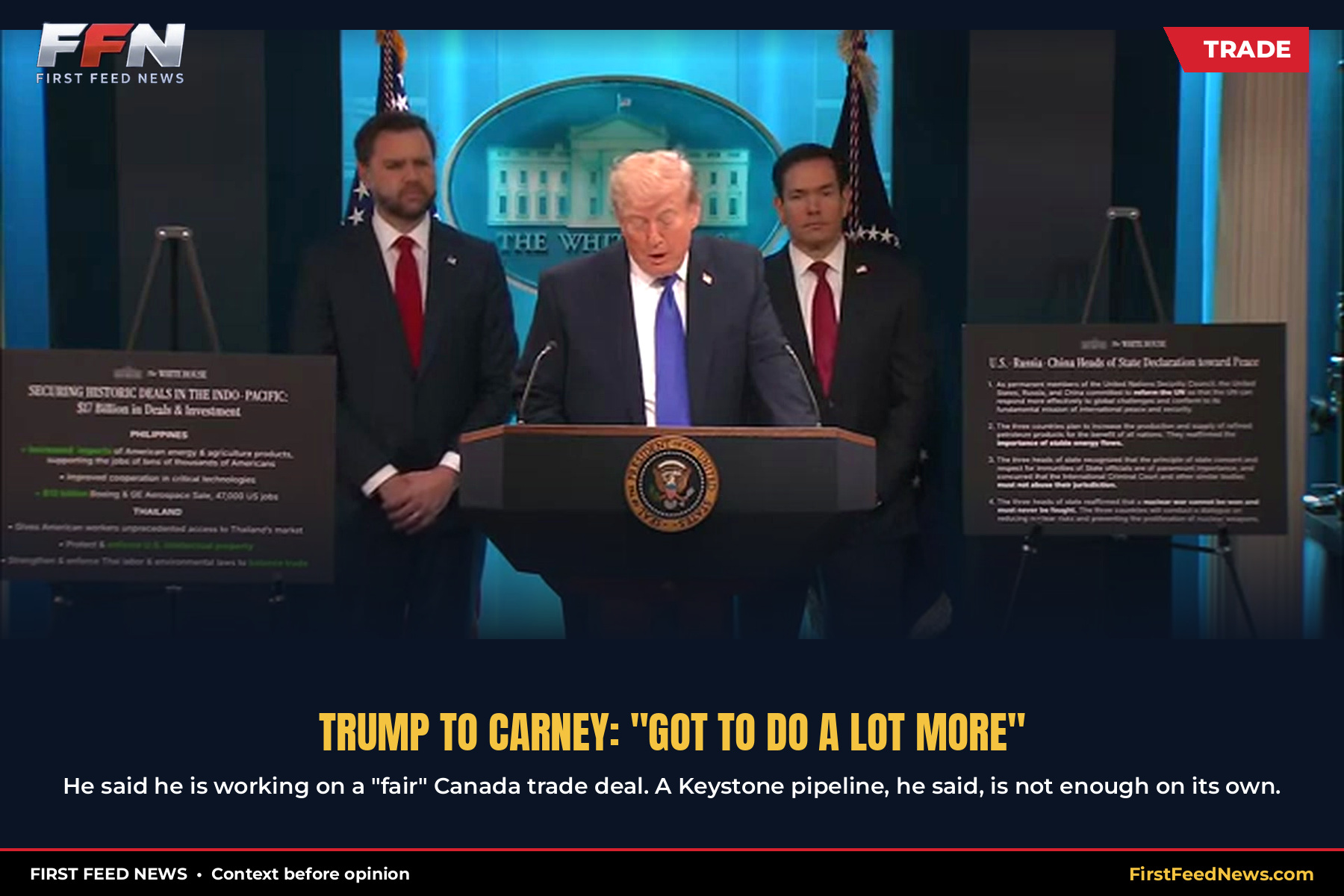
President Donald Trump said Friday he is working on a “fair” trade deal with Canada, but that Prime Minister Mark Carney’s interest in a Keystone pipeline is not enough on its own.
Speaking at a White House news conference after his trip to Asia, Trump said, “While more work remains to be done with Canada, Prime Minister Carney was very nice.” The two men met briefly on the sidelines of the APEC summit in Shenzhen, China, on Nov. 18, a meeting confirmed by the Prime Minister’s Office.
“One of the things he wants to do is build a Keystone pipeline for us. And we like that. But, you know, got to do a lot more than that,” Trump said, in the official White House video of the briefing.
He repeated a long-running complaint that “Canada has been ripping us off for many, many years,” said that “for some reason they feel emboldened,” and added, “we can’t let them feel that way anymore.” He said the United States can make its own cars and has energy and lumber of its own. “With that being said, we’re working on making a deal that’s fair.”
Trump put the U.S. deficit with Canada at “about an $80 billion” figure and said, “When it’s down to zero, come over and let’s start talking.” Official numbers are smaller. The U.S. Census Bureau recorded a $48.3 billion goods trade deficit with Canada in 2025. The United States ran a $27.7 billion services surplus with Canada the same year, according to the Office of the U.S. Trade Representative, which would put the combined goods-and-services deficit near $20.6 billion. Through the first nine months of 2026, the Census Bureau’s goods deficit stands at $38.7 billion.
Secretary of State Marco Rubio, appearing with Vice President JD Vance at the same briefing, said “the unfairness and imbalance that developed” in commercial relations with Canada is well understood, and that Trump’s meeting with Carney “move[d] the ball forward on getting to a final agreement that is good for American workers and fair to the United States of America.”
What Ottawa has actually said
As of Friday evening, Carney had not issued a public statement responding to Trump’s Keystone remark at the news conference. After the Shenzhen meeting, the Prime Minister’s Office said the two leaders discussed “the work underway to reach a mutually beneficial trade agreement that would create good jobs, boost affordability, and fully respect Canada’s languages, culture, and sovereignty,” and “agreed to continue the work and to stay in close contact.”
Hours later on Nov. 18, speaking to the New York Times’ DealBook summit, Carney said Canada and the United States had made some progress but “we’re not there yet” on putting an agreement on paper. “We’d like to do a deal. If the U.S. doesn’t want to do a deal, we’re busy,” he said, pointing to new trade openings with the Philippines, the ASEAN bloc, and other partners.
Canada-U.S. Trade Minister Dominic LeBlanc told CBC on Thursday that an interim deal would likely still include some level of Section 232 tariffs on steel, aluminum, autos, and lumber, though at lower rates. Canada’s chief trade negotiator, Janice Charette, told a House of Commons committee this week that the aim is “the lowest rate of tariff on the narrowest basket of goods,” The Canadian Press reported.
The tariffs still in the way
Talks broke down in August. On Aug. 22, the United States imposed 50% tariffs on selected Canadian goods under Section 338 of the Tariff Act of 1930, Reuters and a Congressional Research Service report said. Those duties sit on top of existing Section 232 tariffs on steel, aluminum, autos, and lumber. Canada answered with retaliatory tariffs beginning Sept. 8. Trump also threatened in August to raise tariffs on vehicles and auto parts to 50% on Jan. 1; CBC reported Friday that Washington had not filed a formal notice of that hike.
Ottawa has been chasing an interim arrangement by year-end to ease those duties. U.S. Trade Representative Jamieson Greer said on Nov. 12, “we want to have a deal that makes sense for them and for us,” The Canadian Press reported.
Separately, the United States declined at the July 2026 joint review to renew the Canada-United States-Mexico Agreement (CUSMA, also called USMCA) in its current form, according to the Congressional Research Service. The pact remains in force until 2036, with annual reviews, unless the three countries agree to extend it, Global Affairs Canada and CRS said.
What “Keystone” actually refers to
The original Keystone XL pipeline was never finished. President Obama denied a presidential permit in 2015. Trump issued one in his first term. President Biden revoked that permit on Jan. 20, 2021, and TC Energy cancelled the project in June 2021.
On April 30, 2026, Trump signed a new presidential permit authorizing Bridger Pipeline Expansion LLC to build border facilities in Phillips County, Montana, to move crude and petroleum products across the U.S.-Canada line — a project that would revive parts of the unused Keystone XL route. Reuters reported the same day that the Canadian pipeline company South Bow, with Bridger as its U.S. partner, is behind the effort.
South Bow’s Prairie Connector would run about 530 kilometers (330 miles) from Hardisty, Alberta, to the border, reusing about 150 kilometers of preserved 36-inch Keystone XL pipe and adding about 380 kilometers of new pipe, then connecting to Bridger’s line toward Guernsey, Wyoming. South Bow has said an open season secured 20-year commitments for 465,000 barrels a day, and that a final investment decision is targeted for mid-2027, subject to permits, land, financing, and “permit durability.” The line is not under construction.
Canadian coverage of Friday’s remarks, including CBC and The Canadian Press, has said Trump’s “Keystone” line most likely refers to that Prairie Connector-style reuse of Keystone XL infrastructure, not a signed Canadian offer to fund the entire original project. Trump has made similar claims before. In early November, he told reporters that Canada would pay to build the Keystone pipeline; the Prime Minister’s Office did not issue a comment on that cost claim at the time, The Canadian Press reported.
What we know
- Trump said Friday he is working on a “fair” deal with Canada, called Carney “very nice,” and said Carney wants to “build a Keystone pipeline for us” but “got to do a lot more than that,” in official White House video.
- He put the deficit at “about an $80 billion.” The Census Bureau’s 2025 goods deficit with Canada was $48.3 billion.
- No trade deal was announced. Carney said on Nov. 18 that “we’re not there yet” and “if the U.S. doesn’t want to do a deal, we’re busy.”
- The 50% Section 338 tariffs imposed in August, and Section 232 sectoral tariffs, remain in place.
- A presidential permit for a Keystone XL-reuse border crossing was signed in April 2026. South Bow’s final investment decision is targeted for mid-2027. The pipeline is not built.
What we don’t know
- Whether an interim tariff deal will be signed by year-end, or what “fair” means on paper.
- Whether Carney offered, in the terms Trump described, to “build a Keystone pipeline for us.” Ottawa has not confirmed that characterization.
- Whether the threatened Jan. 1 auto-tariff increase will be formally imposed.
- Whether Prairie Connector will actually be sanctioned in 2027.
Sources: Official White House video, “President Trump Hosts a News Conference,” Nov. 20, 2026; Secretary of State Marco Rubio, same briefing; Prime Minister’s Office readout, Nov. 18, 2026; Mark Carney, New York Times DealBook summit, Nov. 18, 2026; U.S. Census Bureau, Trade in Goods with Canada; Office of the U.S. Trade Representative, Canada trade summary; Congressional Research Service reports on Section 338 tariffs and the USMCA joint review; Global Affairs Canada, CUSMA joint review; Reuters, April 30, 2026, and August 2026 tariff coverage; White House presidential permit, April 30, 2026; South Bow Prairie Connector project materials and 2026 reports; CBC News; The Canadian Press; The Globe and Mail. Photo: Official White House video still, Nov. 20, 2026, public domain.
Follow First Feed News on Facebook for breaking news first.





Leave a Reply