
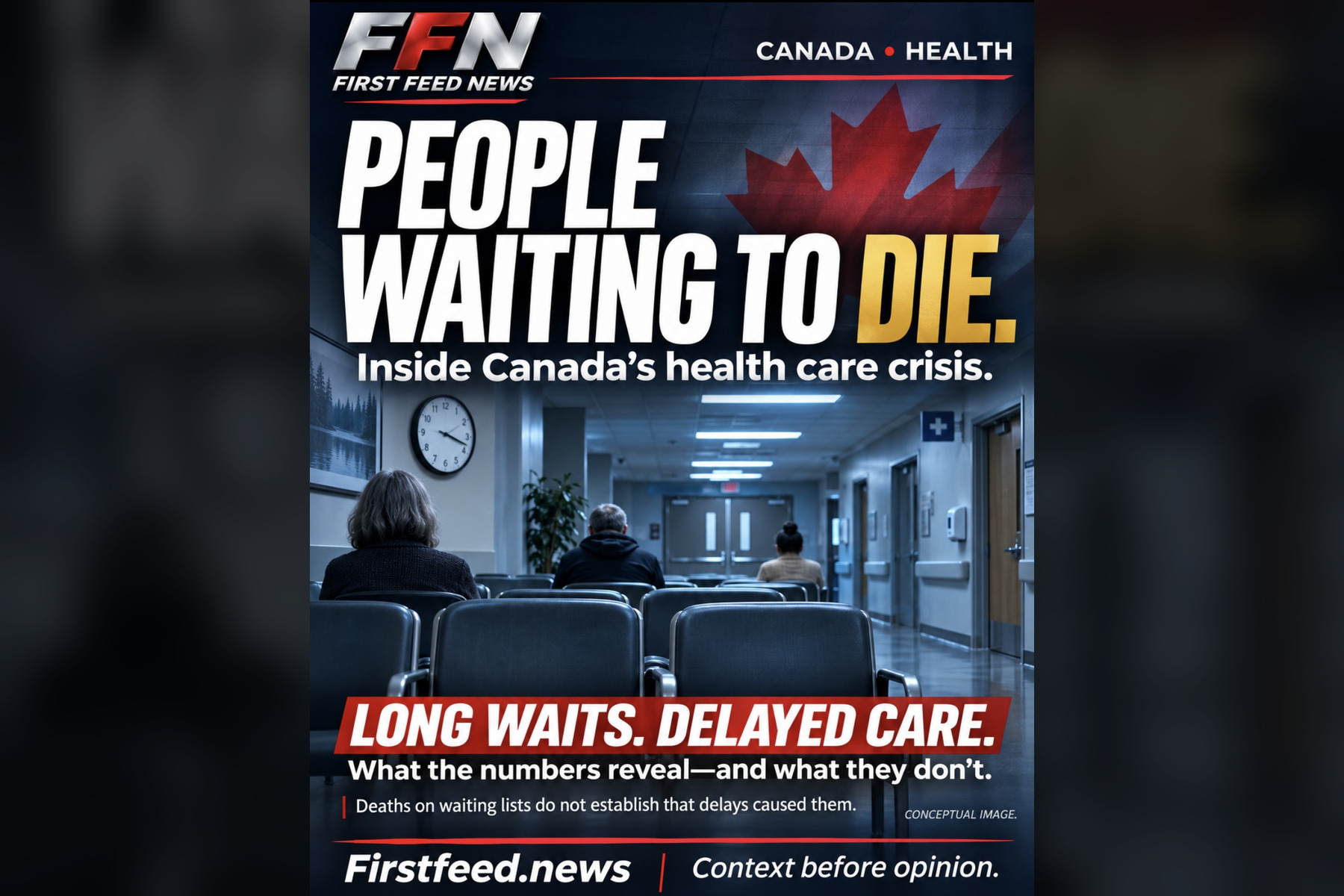
Canada promises health care to every citizen at no direct cost. More and more, what it delivers is a place in line.
The Fraser Institute reported this month that the median wait from a family doctor’s referral to treatment hit 30.7 weeks in 2026, the longest in the 35-year history of its survey and 230% longer than in 1993. Patients are waiting for an estimated 1,463,569 procedures. In New Brunswick the wait is 64.4 weeks. Even an MRI takes a median 18.1 weeks.
Canada at a glance
| Median wait, referral to treatment | 30.7 weeks (record) |
| Died on waiting lists (2024-25) | At least 23,746 |
| Waiting-list deaths since 2018 | More than 100,000 |
| Doctors per 1,000 people | 2.7 (OECD avg. 3.9) |
| ER patients who left untreated (2024) | 1,267,736 |
| Adults with no regular primary care | About 5.8 million |
| Went abroad for care (2025) | About 105,529 |
| MAID deaths (2024) | 16,499, or 5.1% of deaths |
Dying on the list
Through freedom-of-information requests, SecondStreet.org found at least 23,746 patients died while waiting for surgery or a scan between April 2024 and March 2025, pushing the total since 2018 past 100,000. In Ontario alone, 355 died waiting for heart surgery or a cardiac procedure, at least 90 of them after waiting past the recommended timeline.
“No government reports publicly on patients dying on waiting lists,” SecondStreet president Colin Craig said.
The caveat: dying on a waiting list isn’t the same as dying because of it. Many patients were elderly or seriously ill. But no province tracks which deaths timely care could have prevented, and that gap is part of the story.
Spending more, getting less
Canada isn’t short of money. Fraser estimates public health care costs a typical family about $21,115 a year in taxes. Among 32 wealthy countries with universal coverage, Canada ranked second highest for spending but 30th for doctors and 28th of 31 for MRI and CT scanners. The OECD counts 2.7 practising doctors per 1,000 Canadians, against an average of 3.9, and about 5.8 million adults have no regular family doctor or primary care team.
ERs at the breaking point
Without family doctors, Canadians crowd the ER, and many give up. The Montreal Economic Institute found 1,267,736 patients left without treatment in 2024, about one in 13 visits. In Ontario, an average of 1,605 patients a day were treated in hallways in 2025, up 55% from 2018.
Sometimes the wait is fatal. Last December, Prashant Sreekumar, a 44-year-old father of three, died at Edmonton’s Grey Nuns hospital after about eight hours in the ER with chest pain. Alberta ordered a judge-led fatality inquiry.
Cancer: when weeks matter
A 2020 study in The BMJ found each four-week delay in breast cancer surgery raises the risk of death by about 8%. Once diagnosed, most Canadian patients move quickly: half get breast cancer surgery within 22 days, CIHI reports. Getting diagnosed is the bottleneck. CBC reported Halifax-area women facing waits of up to 15 months for a screening mammogram, and British Columbia sent 1,107 cancer patients to Bellingham, Washington, for radiation before ending the program in 2025.
Others don’t wait at all. Fraser estimates 105,529 Canadians paid for treatment abroad in 2025.
Where MAID fits in
Canada’s medical assistance in dying program, called assisted suicide or euthanasia by critics, accounted for 16,499 deaths in 2024, or 5.1% of all deaths, roughly triple the 2019 figure. In Quebec it’s 7.9%. Most recipients (95.6%) were near death, with a median age of 78 and cancer the most common condition.
The controversy centers on 732 “Track 2” cases in 2024, people who weren’t dying. 44.7% of them cited isolation or loneliness as part of their suffering. Ontario’s coroner-led review committee flagged cases driven partly by isolation and fear of homelessness. A Veterans Affairs caseworker improperly raised MAID with four veterans. A 2020 budget office report estimated expanding MAID would cut health costs, while warning that it should “in no way” be read as a reason to. The UN has urged Canada to repeal Track 2.
There’s no evidence of an official policy to steer patients toward MAID to save money, and every case requires independent medical assessments. But a system with long waits and thin social supports can leave vulnerable people with few options. Ottawa’s Bill C-41, which passed second reading 225 to 89 on November 17, would permanently block MAID for mental illness alone, set to begin March 17, 2027.
How Canada compares
Per person, from the OECD’s Health at a Glance 2025:
| Canada | U.S. | France | Chile | |
|---|---|---|---|---|
| Life expectancy | 81.7 | 78.4 | 83.0 | 81.6 |
| Spending per person (US$) | $7,301 | $14,885 | $7,367 | $3,749 |
| Doctors per 1,000 | 2.7 | 2.7 | 3.9 | 3.3* |
| Hospital beds per 1,000 | 2.5 | 2.8 | 5.4 | 1.9 |
| Scanners per million | 26 | 86 | 44 | n/a |
| Treatable deaths per 100k | 58 | 95 | 48 | 78 |
| Covered for core services | 100% | 93% | 100% | 97% |
Americans get faster care: 58% of Canadians waited two months or more for elective surgery, versus 26% of Americans (Commonwealth Fund, 2023). But the U.S. spends twice as much and leaves 7% uncovered, and Canada does better on life expectancy and preventable deaths. France is the fairest test. It also covers everyone and spends almost exactly what Canada does per person, $7,367 versus $7,301. For that money, France has about 45% more doctors per person, more than twice the hospital beds, and 70% more scanners. The French live more than a year longer and have fewer deaths that timely care should prevent. France isn’t perfect, with 60% satisfied with access to care against an OECD average of 64%, but that’s still well ahead of Canada’s 50%. Chile is the eye-opener: it matches Canada’s life expectancy at about half the cost, though it has fewer nurses and beds.
The other side
Defenders note Canadians never get a bill for a doctor or hospital visit, and the OECD rates Canada above average on most overall health measures. Many experts blame decades of under-training doctors and under-buying equipment, not public health care itself. SecondStreet and Fraser are market-oriented think tanks that favor reform, but their numbers come from government records and match the OECD’s data.
The bottom line
Canada covers everyone. It just can’t see them in time. Its outcomes on paper are respectable, but it spends near the top of the wealthy world while ranking near the bottom on doctors, scanners and waits. Coverage for everyone, timely care for too few.
Sources
- Fraser Institute: Waiting Your Turn 2026; Comparing Performance of Universal Health Care Countries 2026; Price of Public Health Care Insurance 2026; Leaving Canada for Medical Care 2025.
- SecondStreet.org, Died on a Waiting List, 2025 edition (incl. Ontario Health cardiac data).
- OECD, Health at a Glance 2025, country notes for Canada, U.S., France and Chile.
- Health Canada, Sixth Annual Report on MAID, 2024; PBO Bill C-7 cost estimate, 2020; Parliament of Canada, Bill C-41.
- Associated Press (Ontario MAID review, 2024); CTV/CBC (Veterans Affairs MAID cases).
- Montreal Economic Institute (ER data, 2025); The Trillium (Ontario hallway care); CMA/OurCare survey, 2026.
- Hanna et al., The BMJ, 2020; CIHI cancer surgery wait times, 2025.
- CBC, CTV, Global News and The Globe and Mail: Halifax mammograms, Quebec MAID, B.C. Bellingham program, Prashant Sreekumar.
- Commonwealth Fund 2023 International Health Policy Survey, via CIHI.






Leave a Reply