
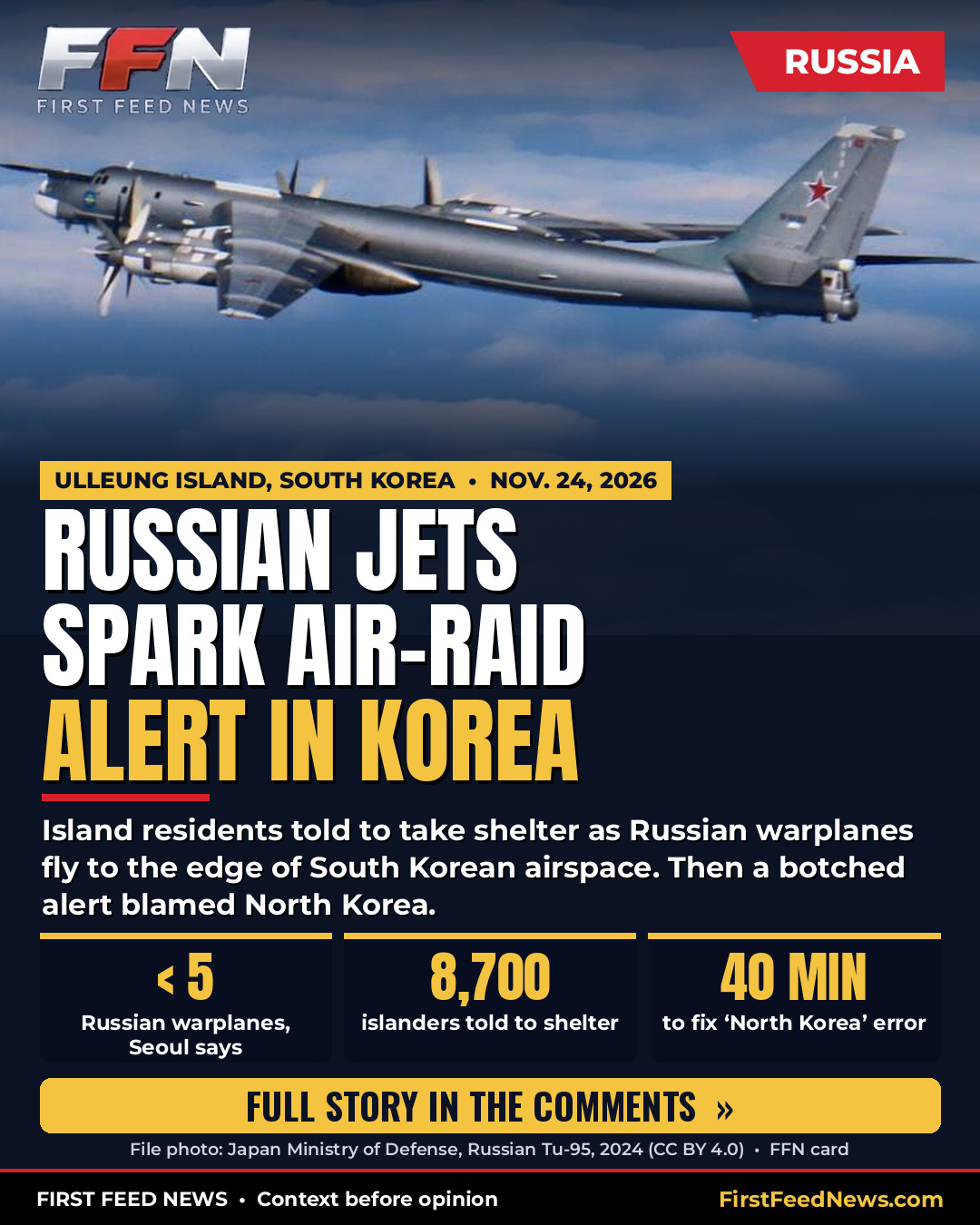
Residents of a remote South Korean island were ordered to take shelter underground Tuesday morning after several Russian military aircraft flew right up to the edge of South Korea’s airspace, prompting Seoul to scramble fighter jets — and a string of confused emergency alerts, one of which wrongly blamed North Korea.
What happened
South Korea’s Joint Chiefs of Staff said fewer than five Russian military aircraft entered the Korea Air Defense Identification Zone (KADIZ) over the East Sea, also known as the Sea of Japan, early Tuesday local time and approached Ulleung Island, about 75 miles off the peninsula’s east coast. The military said it detected the aircraft before they entered the zone and deployed fighter jets to carry out “tactical measures” for contingencies. The Russian planes then turned east and left.
A JCS spokesman, Jang Do-young, said the aircraft came “to the point just before violating” Ulleungdo’s airspace and that, because military jets move so fast, a violation was expected.
‘Take shelter’ — then a mix-up
- 7:52 a.m. (5:52 p.m. ET Monday): The interior ministry sent an air-raid alert to residents of Ulleung County, an island of about 8,700 people, saying Russian aircraft had violated South Korean airspace and urging people to move to underground shelters.
- Minutes later: The alert was lifted as the Russian aircraft left the area.
- The error: North Gyeongsang Province’s all-clear message referred to a “suspected North Korean aircraft.” The province issued a correction about 40 minutes later. Several major South Korean outlets had already run breaking-news alerts based on the initial warning.
- The military’s account: The JCS later said Russian aircraft did not violate South Korea’s territorial airspace and that no North Korean aircraft were involved. It called the alert a pre-emptive step to protect residents and acknowledged it was “unusual.”
Seoul to protest
South Korea’s defense ministry said it would summon Russia’s military attaché in Seoul on Tuesday afternoon to lodge a stern protest. There was no immediate comment from Moscow.
An air defense identification zone is not sovereign airspace but a buffer in which countries ask approaching aircraft to identify themselves. Russian and Chinese military aircraft have repeatedly entered South Korea’s zone in recent years without notice.
The incident comes as former Russian President Dmitry Medvedev, deputy head of Russia’s Security Council, writes that Russia could launch a “preventive” nuclear strike under certain circumstances, and as NATO’s chief vows to defend against Russian threats in space.
What we don’t know
- The type of Russian aircraft involved; the JCS did not say.
- Why the provincial message named North Korea; South Korean officials said they were still looking into it.
- Whether Moscow will respond to Seoul’s protest.
Sources: South Korea Joint Chiefs of Staff and Ministry of National Defense briefing; Yonhap; AFP; The Guardian; SBS. File photos: Japan Ministry of Defense / JASDF (CC BY 4.0); U.S. Department of Defense (public domain); NASA Landsat 7 (public domain); Korea.net / KOCIS (CC BY-SA 2.0); Republic of Korea Armed Forces (CC BY-SA 2.0).







Leave a Reply