
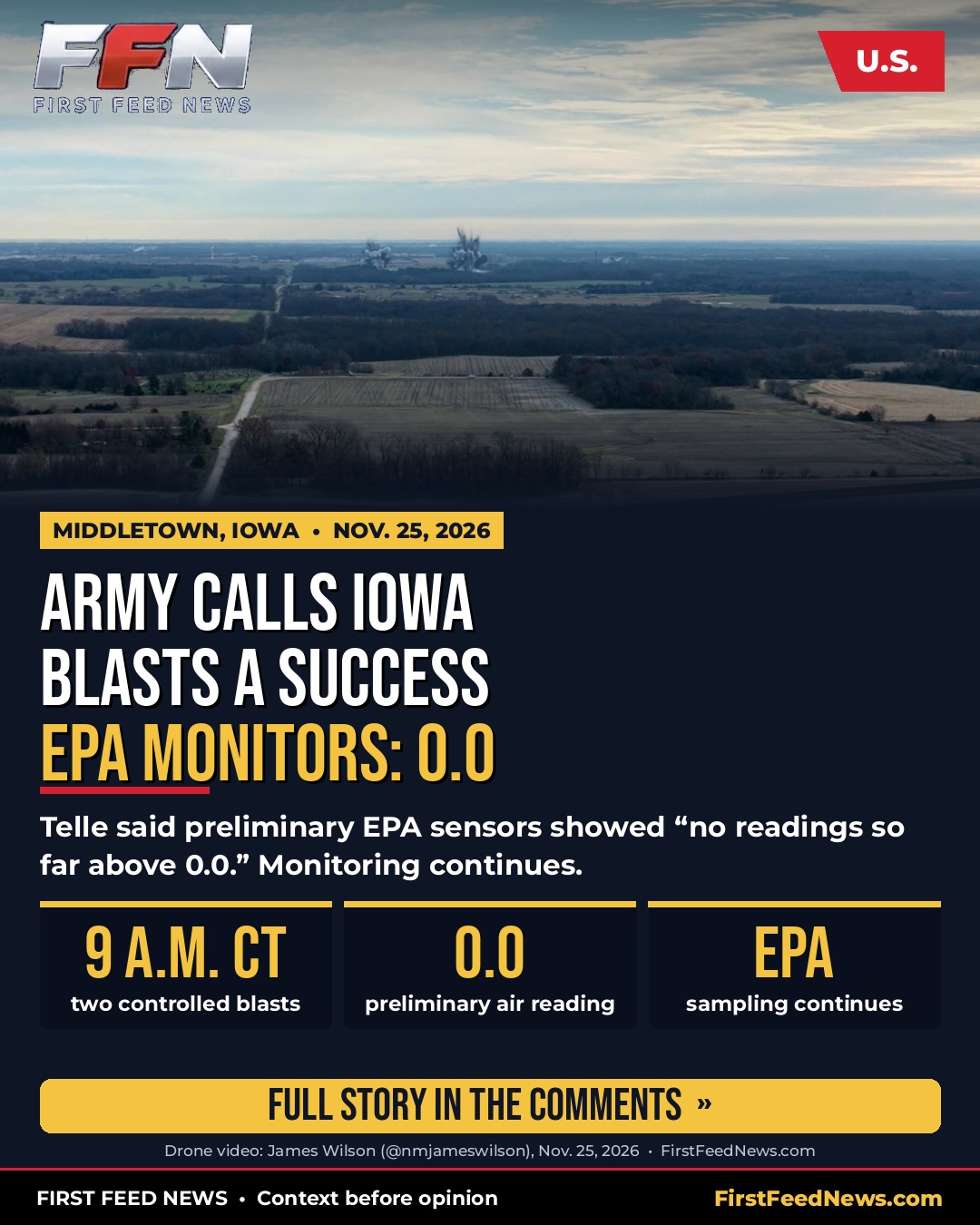
The U.S. Army destroyed the nation’s degraded lead-azide stockpile at the Iowa Army Ammunition Plant this morning, then called the operation a “HUGE success” after preliminary real-time air monitors showed no airborne lead.
The two controlled detonations were carried out around 9 a.m. CT Wednesday at the plant in Middletown, in southeastern Iowa, ending a brief legal fight over fears that toxic lead dust could reach homes, farms and livestock.
‘No readings so far above 0.0’
Acting Army Secretary Adam Telle said on X that the “controlled, mitigated detonation exceeded all expectations and was a HUGE success,” and that “the threat of an uncontrolled spontaneous detonation has been eliminated.” He said the Army was watching “EPA’s MASSIVE sensor array throughout the area closely, and there are no readings so far above 0.0,” according to The Hill, which reported the post.
The Associated Press reported that none of the EPA’s real-time air monitors had detected airborne lead more than an hour after the blasts. The EPA had said before the detonations that those monitors would report data every five minutes.
Monitoring is not finished
Officials have been careful to call the early air figures preliminary. The EPA said it collected 1,216 pre-blast samples of air, soil, dust and water and deployed about 300 personnel and contractors to the plant and surrounding areas. Post-blast sampling and any cleanup, the agency said, would continue after the detonations. The EPA also said a brief increase in airborne lead was possible even with mitigation measures in place.
Residents had been told to stay inside
Before the blasts, Iowa Gov. Kim Reynolds declared a disaster emergency in Des Moines, Lee and Van Buren counties. Missouri health officials told residents living 5 to 20 miles southwest of the plant to shelter indoors until an all-clear, according to AP, the WSJ and other accounts. Reynolds later said initial feedback from state and federal partners was that the detonation was successful and that the Army would hold a press briefing.
Why the Army said it had no other choice
The Army said the lead azide, a sensitive explosive used to set off other munitions, had degraded and was at risk of exploding uncontrollably as temperatures cooled. Assistant Secretary of the Army Jordan Gillis said the choice was between “a spontaneous, uncontrolled detonation” and a controlled one at a time and place the Army could choose, AP and other outlets reported. Officials said crews reinforced bunkers, built berms and used water sprays to try to limit how far any dust could travel.
Drone video posted by storm chaser James Wilson shows two white plumes rising over the plant from several miles away and then thinning. The Associated Press published the same scene. The clip is embedded below, credited to Wilson.
What we don’t know yet
- Whether later soil, water and dust tests will stay as clean as the first air readings.
- How far any residue traveled beyond the plant.
- The final public health guidance for nearby homes and farms.
First Feed News will update this story as more test results are released.







Leave a Reply