
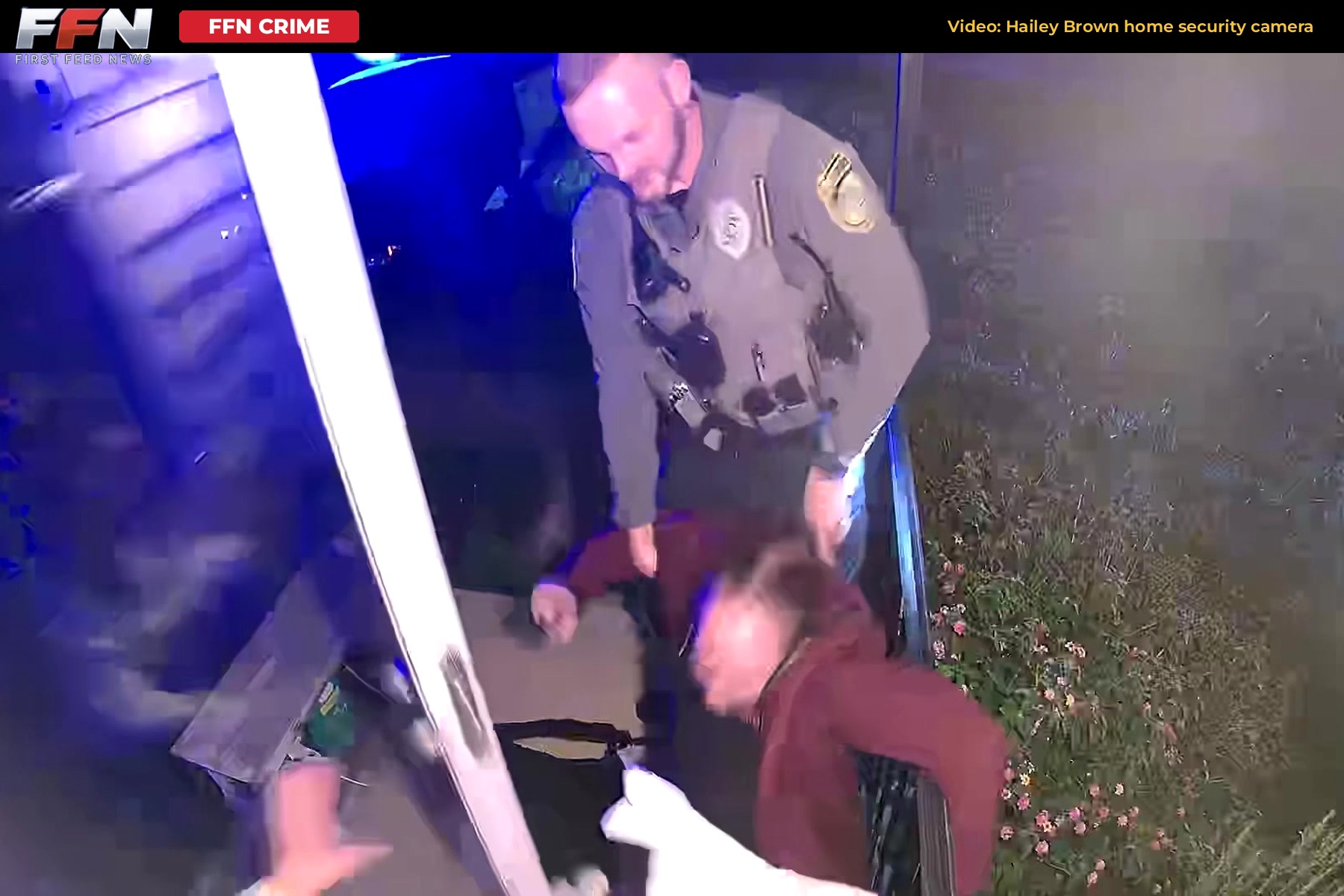
Home security cameras in Lowell, North Carolina, show a Gaston County police officer forcing open a woman’s front door, pulling her out of the house and taking her to the ground — after she says she flashed her headlights to warn other drivers that a police car was parked in the median. The charges that followed include resisting a public officer and traffic counts. One of them, failing to dim headlights, carries a penalty of no more than $10 under North Carolina law.
What the cameras recorded
The encounter happened shortly after 2 a.m. on Thursday, Nov. 19, 2026, in Lowell, a Gaston County town about 16 miles west of Charlotte. The cameras’ own timestamps show Hailey Rhiannon Brown, 31, pulling into her driveway at 2:19 a.m. A patrol car comes down the street behind her. By the time she is at her front door, blue lights are flashing. She turns toward the officer and asks whether she has done something wrong.
“Is it illegal to let people know?” she asks, as the officer comes up the walk. The video then shows him closing the distance quickly, forcing the door as she tries to shut it, grabbing her and pulling her out of the doorway. She can be heard shouting at him, cursing, telling him not to let her dog out and saying she is not resisting. A second officer arrives and helps restrain her. Her grandmother, who lives with her, comes to the door and can be heard pleading with the officers: “Please don’t do this.” Brown also yells that they are going to give her grandmother a heart attack.
Brown later told a Charlotte television station the officer “flew like a linebacker,” busted the door open and started “ripping me out of my house.” She said she was left with bruises on her arm and that the encounter has left her and her grandmother afraid in their own home. Those injuries have not been independently documented and are marked UNCONFIRMED beyond her account.
She says it was a warning. Police say she fled a stop.
Brown has said she was driving home from work along Wilkinson Boulevard near Westover Street when she saw a Gaston County police car parked in the median with its lights off. She said she briefly flashed her headlights, as she does for police, wrecks or other hazards, to warn oncoming drivers. She says the officer did not turn on his emergency lights or make a stop on the road, and that she had no idea anyone was trying to pull her over until she was already in her driveway or at the door.
The arrest report, as described by outlets that reviewed it, including the New York Post and the Daily Mail, tells a different story. It alleges that Brown resisted, delayed or obstructed an officer by running away from a vehicle during a traffic stop after being ordered to stop. The report identifies the officer’s duty at the time as conducting that stop.
The publicly available cameras cover the driveway and the front door. They do not show what happened on Wilkinson Boulevard before she got home. Brown has asked the department to release the officer’s body-worn camera and dashboard camera recordings, saying she wants the public to see the full encounter, “not just my side.” Those recordings have not been released. Under North Carolina law, G.S. 132-1.4A, police body-camera and dash-camera video is not a public record; public release generally requires a court order.
The charges are a misdemeanor and traffic counts
Gaston County jail records show Brown was booked at 3:41 a.m. and released at 5:11 a.m. the same morning on a $3,500 secured bond. Four counts are listed as pending on docket 26CR456798:
- Resisting a public officer, a misdemeanor
- Expired registration
- An inspection violation
- Failure to dim headlamps
The booking originated with the Gaston County Police Department, not a city Lowell police force. The inmate record is posted on the county jail inquiry site. The charges are allegations. Brown is presumed innocent unless proven guilty.
North Carolina’s headlamp law, G.S. 20-131, requires a driver who is meeting another vehicle to dim or otherwise control the beams so they do not throw a glaring light on people within 500 feet. G.S. 20-181 sets the penalty for failing to dim — when meeting another vehicle, or when following within 200 feet — at no more than $10. That is the traffic count tied to the headlights. Whether a brief warning flash is the same thing as a failure-to-dim violation is a question the courts, not a booking log, will have to sort out.
The legal fight at the front door
Timothy Cannady, an attorney with Leitner, Bragg and Griffin, told a Charlotte television station that flashing headlights to warn other drivers about police is generally protected speech under the First Amendment. “It’s protected free speech to warn others that the cops are there,” he said. He also said an officer who has reasonable suspicion of a traffic violation can still make a stop, and that a charge of resisting a public officer depends on whether the officer was carrying out a lawful duty and giving a lawful order. “If he wasn’t giving a lawful order, then it’s not a resist,” Cannady said. He was commenting on the legal questions in the case; he has not been identified as Brown’s lawyer.
A separate question is whether the officer should have crossed the threshold of the house at all. The U.S. Supreme Court held in Lange v. California (2021) that hot pursuit of a fleeing suspect does not automatically allow police to enter a home without a warrant when the underlying offense is a misdemeanor. The charges in this case are a misdemeanor plus traffic infractions, not felonies. No court has yet ruled on the entry in Brown’s case. Legal commentators have argued that, on this record, the officer should not have forced the door or put hands on her inside her home over a headlight warning and minor vehicle counts. That argument has not been tested in this prosecution.
The department, the chief, and the review
Gaston County Police is a county department, created in 1957, that patrols unincorporated parts of the county and some small towns. The county’s official police page says the department employs more than 150 sworn officers and has been accredited by CALEA since 1991. It is led by Chief of Police Stephen Zill, who is listed as chief on the Gaston County Police page and is responsible for the overall operation of the department. Assistant Chief Anderson Holder oversees the Investigations and Support Services Division, which includes the Professional Standards Unit.
The department’s published use-of-force policy, 1.3.1, says officers will use only the minimum amount of force necessary and reasonable to control a situation, make an arrest, overcome resistance or defend themselves, and that no officer will use unreasonable or excessive force. Force is supposed to be progressive when possible, beginning with verbal commands. Any use of force, the policy says, must be reported in writing to a supervisor and forwarded to the chief of police. Officers who see another officer use excessive force are required to intervene and report it. Formal complaints against police employees are investigated by the Professional Standards Unit, which reports directly to the Office of the Chief of Police.
Holder gave the department’s only public comment, telling a Charlotte television station: “The Gaston County Police Department reviews all use-of-force incidents involving its officers, and this incident is currently under review. As this matter is proceeding through the judicial process, the department has no further comment at this time.”
No finding from that review has been announced. There has been no public statement that the officer was placed on leave, reassigned or disciplined. The department has not publicly named the officer. Posts circulating on Facebook, including Brown’s account of the arrest, have identified him as Carson Jenks. The Daily Mail, citing court records it said it reviewed, named Gaston County Police Officer C.L. Jenkins. First Feed News has not independently confirmed either name from an official record, and the two spellings have not been reconciled. This report therefore refers to him as a Gaston County police officer. The second officer has not been identified.
What comes next
A Charlotte television station reported that Brown is due back in court in January. That date is UNCONFIRMED: the jail record lists no court date, and First Feed News was not able to pull docket 26CR456798 from North Carolina’s public eCourts portal during reporting.
Brown has said she plans to file a formal complaint with the department and wants the body-camera and dash-camera video released. It is not confirmed that a complaint has been filed, and no lawsuit was located. She has started a GoFundMe to hire a North Carolina attorney and to have the police recordings reviewed with her own cameras. No statement from the ACLU of North Carolina, or from Lowell or Gaston County elected officials, was found beyond the department’s review comment.
The longest public version of the home-camera footage is an 8-minute, 30-second compilation of 11 clips, posted on YouTube on Nov. 27, that the uploader says follows Brown’s original Facebook video and keeps the original timestamps. It is here. First Feed News edited a shorter version for this report, in the same chronological order, including the arrival, the questions at the door, the officer forcing the door, the struggle and the grandmother’s pleas.





Leave a Reply