
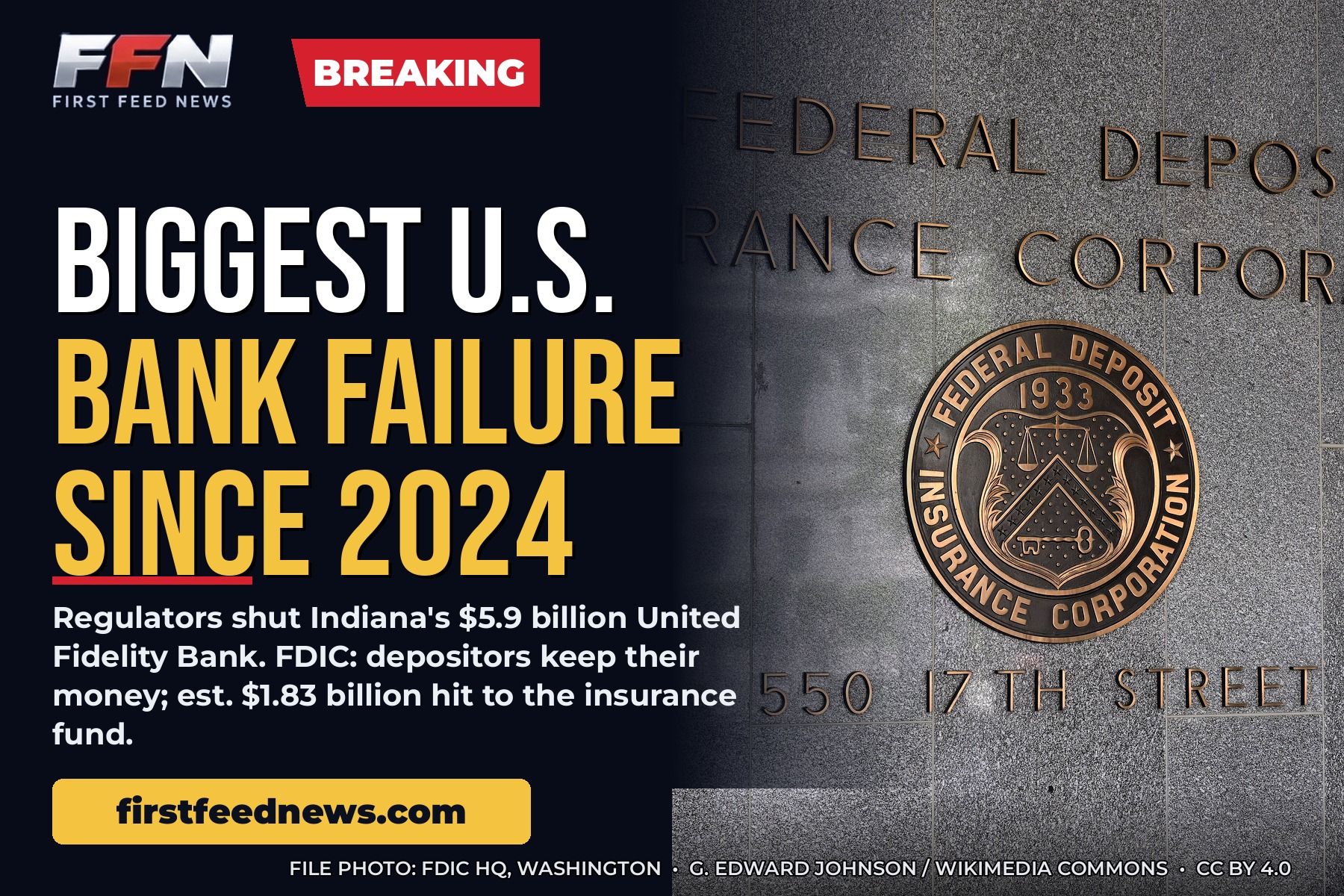
BREAKING: Federal regulators shut down Evansville, Indiana-based United Fidelity Bank on Friday, the biggest U.S. bank failure since Philadelphia’s Republic First Bank collapsed in April 2024, according to Federal Deposit Insurance Corporation records. The FDIC says the failure will cost its Deposit Insurance Fund an estimated $1.83 billion.
Get all the updates at firstfeednews.com.
The Office of the Comptroller of the Currency closed the $5.9 billion lender after finding it was “in an unsafe or unsound condition to transact business and was likely to be unable to pay its obligations or meet its depositors’ demands in the normal course of business,” the OCC said in a statement. The OCC named the FDIC as receiver.
Is the money safe?
Yes, according to the FDIC. Raleigh, North Carolina-based First-Citizens Bank & Trust Company agreed to take over substantially all of United Fidelity’s deposits and buy substantially all of its assets. “No one lost any money on deposits as a result of the closure of this bank,” the FDIC said in its customer guidance.
- United Fidelity’s 22 branches in Indiana, Illinois, Florida, Colorado and the U.S. Virgin Islands reopen as First Citizens branches: Saturday at locations with Saturday hours, and Monday at all others, the FDIC said.
- Customers can keep using their checks, ATM and debit cards over the weekend. Direct deposits, such as paychecks and Social Security, continue as usual, and loan customers should keep making payments, the FDIC said.
- Certain brokered deposits are excluded from the transfer, the FDIC said; customers who hold United Fidelity deposits through a broker are told to contact their broker.
- FDIC call center: 1-866-431-1725.
Red flags for years
The scale of the loss stands out. The FDIC’s $1.83 billion estimate is roughly 31% of United Fidelity’s $5.9 billion in total assets as of Sept. 30. First Citizens said its winning bid came with an asset discount of about $2.6 billion and no deposit premium, and that it will take on about $4.5 billion in deposits and $3.1 billion in loans, compared with the $5.4 billion in total deposits the FDIC listed for the bank.
Regulators had been warning about the bank for years. The OCC issued an enforcement action in October 2023, and in June 2024 the Federal Reserve hit United Fidelity and its parent companies, Fidelity Federal Bancorp and Pedcor Financial Bancorp, with a cease-and-desist order over capital planning, risk management, contingency funding and board oversight, Banking Dive reported at the time. A bank spokesperson then blamed the regulator’s concern on the bank’s fast growth in affordable housing finance.
United Fidelity grew partly by buying other banks, including failed ones: FDIC records list it as the buyer of First City Bank of Florida when that bank failed in October 2020.
First Citizens does it again
First Citizens was also the buyer of Silicon Valley Bank after its 2023 collapse. “We believe this transaction is both financially and strategically compelling,” First Citizens CEO Frank Holding Jr. said in a statement. The deal also includes United Fidelity’s subsidiaries, among them real estate developer Pedcor Homes Corporation, and two U.S. Virgin Islands branches that operate as Bank of St. Croix, the company said.
United Fidelity is the seventh U.S. bank to fail in 2026 and by far the largest, according to the FDIC’s failed-bank list. The bank’s holding company, Fidelity Federal Bancorp, was not part of the receivership, the FDIC said.
Still unknown
- What finally tipped the bank over after years under regulatory orders, and why the loss to the insurance fund is so large.
- How many brokered deposits were left out of the transfer, and what happens to them.
- Whether lawmakers or regulators will call for a review of how the bank was supervised.
File photo: Federal Deposit Insurance Corporation headquarters sign, Washington, D.C. (G. Edward Johnson, Wikimedia Commons, CC BY 4.0).
Follow this story: updates here at firstfeednews.com.






Leave a Reply